1. Why Source BBQ Grills from China? (The B2B Advantage)
1.1 Unmatched Cost-Effectiveness and Profit Margins
China remains the world’s most competitive manufacturing base for outdoor cooking equipment. Thanks to mature supply chains, low labor costs, and mass production of raw materials (stainless steel, cast iron, aluminum), we can offer prices that are 30-50% lower than factories in Europe or North America – while maintaining the same or better quality. This translates directly into higher margins for your brand.
1.2 Advanced R&D and Manufacturing Capabilities
Gone are the days of “cheap and low quality.” Today, leading Chinese factories invest heavily in automation (robotic welding, CNC punching), CAD/CAM design, and in‑house tooling. We can produce complex foldable tent stoves, high‑efficiency rocket stoves, and smart gas grills with electronic ignition. Many of us also hold ISO 9001 and have dedicated R&D teams that release dozens of new models every year.
1.3 The Complete Supply Chain for Outdoor Gear
China’s industrial clusters mean that everything you need – stainless steel coils, heat‑resistant paint, ceramic briquettes, rubber feet, plastic handles, custom cartons – is available within a 100‑kilometer radius. This reduces lead times and lowers the risk of material shortages. When you work with a factory in Guangdong or Zhejiang, you are tapping into an entire ecosystem.
2. Types of BBQ Grill Suppliers in China: Which is Right for You?
2.1 Trading Companies vs. Direct Factories – How to Tell the Difference
Trading companies act as middlemen. They speak good English and offer a wide product range, but you will pay 15-25% more and have no direct quality control. Direct factories own the production line. We can show you our workshop, weld lines, and testing equipment. To verify: ask for a business license that includes “manufacturing” in the scope, request a video call from the shop floor, and compare the export records – factories usually show consistent HS code shipments.
2.2 OEM Specialists (Original Equipment Manufacturer)
OEM factories produce exactly to your drawings and specifications. You provide the design, material choices, dimensions, and packaging artwork. We handle production and quality control. This option is ideal for established brands with unique product designs. Minimum order quantities (MOQs) for full OEM are typically 500-1000 units.
2.3 ODM Experts (Original Design Manufacturer)
ODM factories have ready‑made designs that you can put your brand on (private label). This is the fastest way to launch a new grill or stove. You choose from our catalog, we add your logo, packaging, and manuals. MOQs for ODM are lower – often 100-300 units. Many successful Amazon sellers started with ODM and later moved to OEM.
3. Key Manufacturing Hubs for Outdoor Cooking Equipment in China
3.1 Guangdong Province: High-End Gas Grills and Smart Grills
Guangdong (especially Foshan, Zhongshan, and Dongguan) is the center for gas grills, electric smokers, and smart outdoor cookers. Factories here excel at precision stamping, gas valve manufacturing, and electronic ignition systems. If you need a high‑end built‑in BBQ with side burners and temperature control, Guangdong is the place.
3.2 Zhejiang Province: Portable Camping Stoves and Tent Stoves
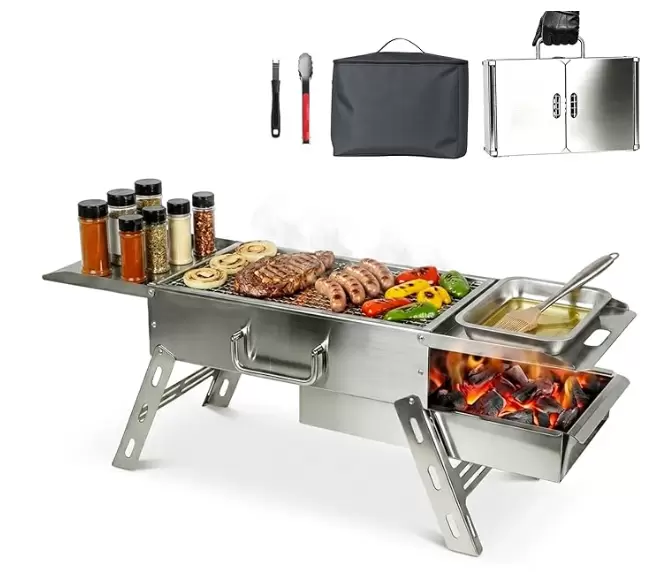
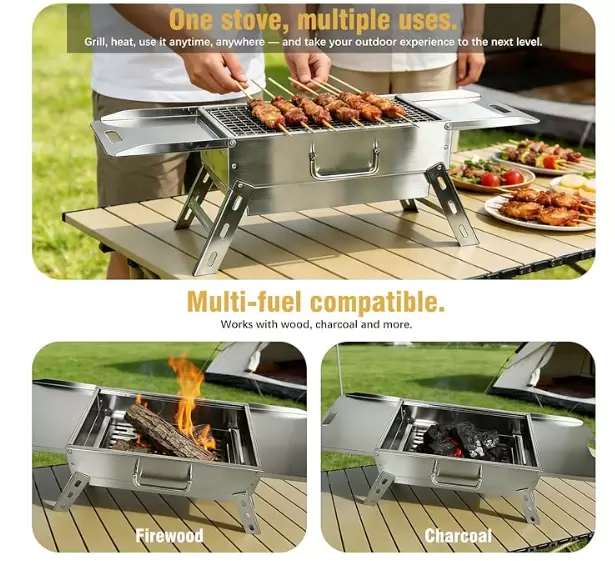
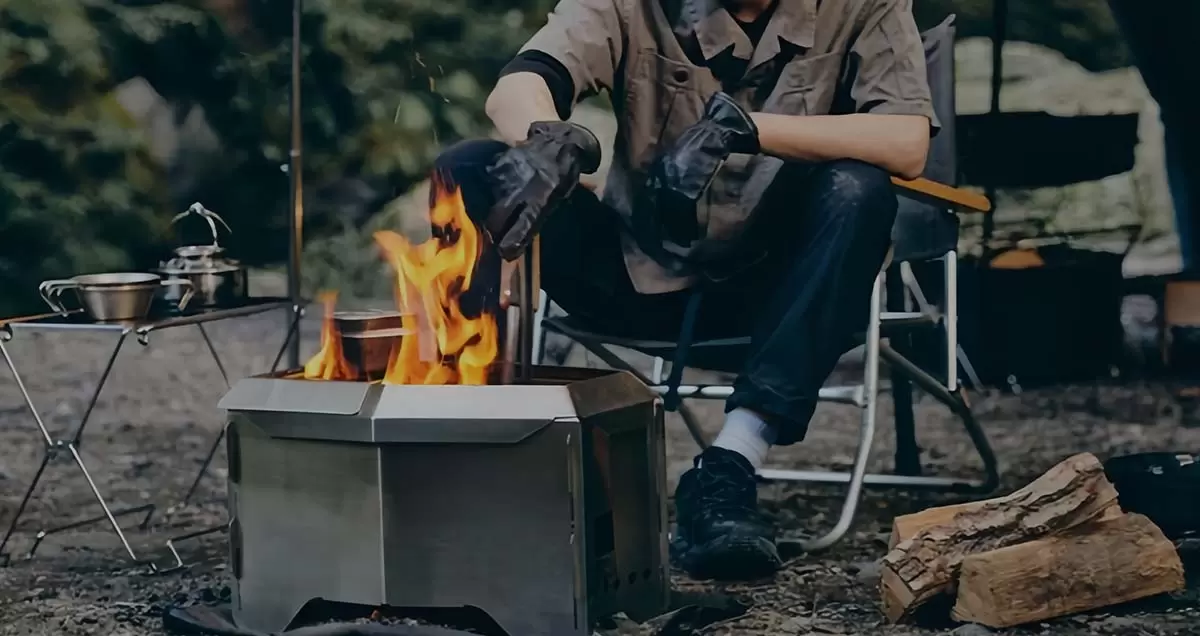
Zhejiang (Yongkang, Ningbo, and Hangzhou) is famous for small outdoor stoves, folding wood stoves, and portable camping grills. Yongkang is known as “Hardware Capital” – you will find hundreds of factories making foldable tent stoves, rocket stoves, and stainless steel burners. We are located in this hub, which gives us access to the best raw materials and component suppliers.
3.3 Jiangsu & Shandong: Heavy-Duty Commercial Grills and Charcoal Kettles
Jiangsu (Nanjing, Changzhou) and Shandong (Qingdao, Linyi) specialize in heavy‑duty charcoal grills, offset smokers, and commercial kitchen equipment. If your target market is restaurants, catering, or large outdoor events, these provinces offer thicker steel and welded constructions. Qingdao is also a major port, making export logistics easier.
4. Step-by-Step Guide to Finding Suppliers Online
4.1 Leveraging Alibaba and Global Sources Effectively
Alibaba and Global Sources are the largest B2B platforms. To find real factories, use the “Verified Supplier” filter and look for “Trade Assurance” and “Assessed Supplier” badges. Pay attention to the “On‑time Delivery Rate” and “Response Rate” – below 85% is a red flag. Send detailed inquiries (not just “please send catalog”) to separate serious suppliers from traders.
4.2 Using Made-in-China (MIC) for Factory Verification
Made‑in‑China (MIC) offers a “Audited Supplier” service where third‑party inspectors visit the factory. You can view the audit report, including photos of the workshop, number of employees, and key equipment. We maintain a Gold Supplier status on MIC, and our audit report is publicly available.
4.3 Searching Google for Independent Manufacturer Websites
Many high‑quality Chinese manufacturers have their own websites but do not invest heavily in B2B platforms. Use search strings like:
“stainless steel camp stove manufacturer Zhejiang”
“OEM folding BBQ grill China factory”
“tent wood stove supplier Ningbo”
Look for sites with “.cn” or dedicated “Factory” pages. Independent sites often show more technical details, certifications, and real case studies. This is a great way to find factories that are not overloaded with Alibaba inquiries.
5. How to Evaluate and Verify a BBQ Grill Factory's Legitimacy
5.1 Checking Business Licenses and Export Records
Ask the supplier for their business license . The registered capital, establishment date, and business scope must include “manufacturing” . You can also use import/export data tools like Panjiva or ImportGenius to see if the company has shipped products that match your category. Consistent export history is a strong sign of reliability.
5.2 Analyzing ISO 9001 and Quality Management Systems
ISO 9001:2015 certification is the minimum standard for a professional factory. But do not stop at the certificate – ask how they implement it: Do they have incoming material inspection? In‑process quality checks? Calibrated measuring tools? We share our quality control flow chart with every serious buyer.
5.3 Requesting Virtual Factory Tours and Video Audits
A picture is no longer enough. We recommend asking for a live video call (WeChat, Zoom, or Teams) where the salesperson walks through the workshop, shows you the production line, raw material storage, and testing area. For an extra layer of verification, you can hire a local inspection company to conduct an unannounced audit. We welcome both.
6. Essential Certifications for Importing BBQ Grills
6.1 CE and LFGB Certifications for the European Market
For the EU, gas grills and charcoal grills often need CE certification (product safety) and LFGB (food contact materials). LFGB is stricter than the US FDA – it tests for heavy metal migration and sensory odor. We can provide both certificates for all our export models. If you need a custom design, we will submit it for testing (additional cost and lead time).
6.2 FDA and CSA Approvals for the US Market
US buyers should look for FDA (for food‑contact surfaces) and CSA (for gas grills). CSA is the recognized safety standard for gas appliances. Electric grills may require UL or ETL. We hold FDA test reports for our stainless steel materials and can work with a CSA‑certified lab for gas models. Do not accept “self‑declared” CE or “equivalent” certificates – always request the original test report.
6.3 Understanding RoHS and Environmental Standards
RoHS restricts hazardous substances (lead, mercury, cadmium, etc.) in electronic components and coatings. Even if your product is purely mechanical, paint and plastic parts may need RoHS compliance for the EU. We provide RoHS declarations for all painted and plastic components. More buyers are also asking for REACH and Prop 65.
7. Mastering the Sample Ordering and Testing Process
7.1 How to Communicate Custom Specifications (Tech Packs)
A good tech pack (spec sheet) includes: material thickness, dimensions, welding points, finish type (powder coat or high‑temp paint), and packaging details. Use a simple table or CAD drawing. We provide a template tech pack to all new clients. The clearer your specs, the fewer surprises during mass production.
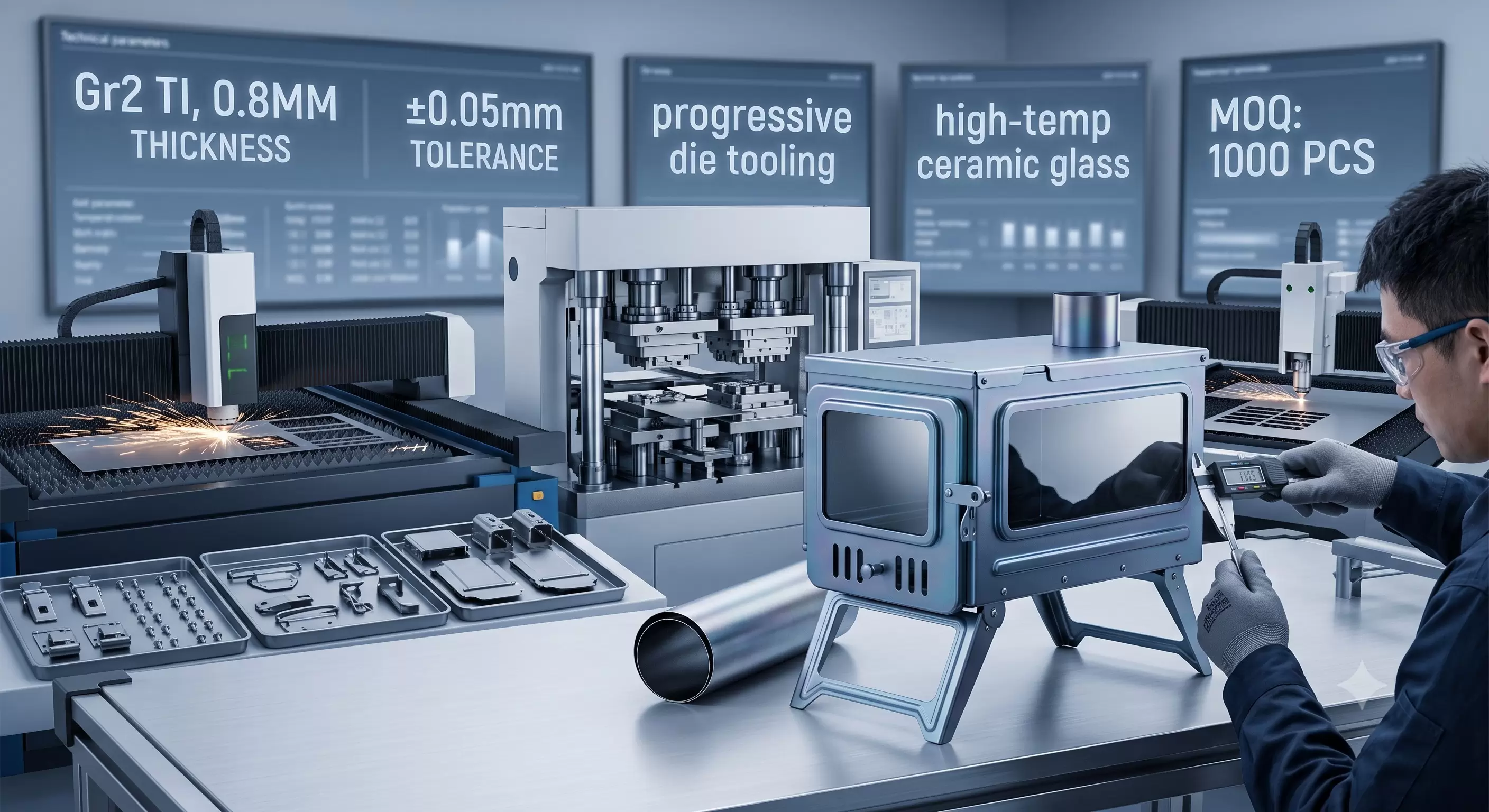
7.2 Evaluating Material Quality: Titanium vs. Stainless Steel
For portable grills and stoves, 304 stainless steel is the standard choice – it is rust‑resistant, easy to clean, and affordable. 430 stainless steel is magnetic and cheaper but may rust in coastal environments. Titanium is ultra‑light (40% lighter than steel) and corrosion‑proof, but costs 4-5 times more. We offer all three options. For most buyers, 304 stainless steel is the best balance of cost and performance.
7.3 Testing Heating Efficiency and Folding Mechanisms
When you receive a sample, test it under real conditions:
How long does it take to boil 1 liter of water?
Is the folding mechanism smooth? Are the locking pins secure?
After cooling, inspect for weld cracks or paint peeling.
We encourage buyers to video the test and share feedback. This helps us fine‑tune production.
8. Negotiating MOQ, Pricing, and Payment Terms
8.1 Strategies for Lowering Minimum Order Quantities (MOQ)
High MOQs are a common barrier. Here is how we help: (1) For ODM models, we can offer 100‑200 units for a trial. (2) You can combine different models (e.g., 50 tent stoves + 50 rocket stoves) into one container – we count this as one order. (3) We accept an extra 5-10% unit cost to lower MOQ. After a successful first order, we will negotiate better terms.
8.2 Understanding Shipping Terms: FOB, EXW, and CIF
EXW (Ex Works): You pick up from our factory. Cheapest but most responsibility.
FOB (Free on Board): We deliver to the named port (e.g., FOB Ningbo). You pay sea freight. Most common for experienced buyers.
CIF (Cost, Insurance, Freight): We arrange and pay for shipping and basic insurance. More expensive but less hassle.
We quote FOB Ningbo by default. For new clients, we recommend starting with FOB to understand logistics.
8.3 Safe Payment Methods for B2B Orders (T/T, L/C, Trade Assurance)
T/T (Telegraphic Transfer): 30% deposit, 70% against copy of B/L. Standard and safe.
L/C (Letter of Credit): For large orders >$50,000. Banks guarantee payment but involve more paperwork.
Trade Assurance (Alibaba): Third‑party escrow – good for small first orders.
We accept all three. For T/T, we provide proforma invoice with our bank details. Never pay 100% upfront.
9. Quality Control (QC) and Pre‑Shipment Inspections
9.1 Hiring Third‑Party Inspection Agencies (SGS, TUV, Bureau Veritas)
Before shipment, you can hire SGS, TÜV Rheinland, or Bureau Veritas to inspect the goods. They will check dimensions, weld quality, paint thickness, packaging, and random function tests. Cost is typically $300-600 per container. We have cooperated with these agencies for years and will facilitate their visit.
9.2 Defining Your Acceptable Quality Limit (AQL)
AQL is the maximum number of defective units allowed in a batch. A common AQL for outdoor stoves is 1.5 (major defects) and 4.0 (minor defects). We will agree on the AQL in the sales contract. If the inspection fails, we will rework or discount.
9.3 Common Defects to Watch for in Outdoor Stoves
Based on thousands of inspections, the most frequent defects are:
Poor welds (pinholes or incomplete penetration)
Rust spots on unpainted steel (from humid storage)
Misaligned folding legs or loose hinges
Carton damage (poor stacking in container)
We address all these with in‑process checks and 100% final inspection on critical models.
10. Building a Long‑Term Partnership with Your Supplier
10.1 Effective Cross‑Cultural Communication Strategies
Chinese business culture values relationship (guanxi) and clear communication. Be specific about your quality expectations. Avoid “maybe” or “as soon as possible.” We appreciate regular updates from your side – even a quick email every two weeks helps us plan production. Learn a few Chinese phrases ; it goes a long way.
10.2 Protecting Your Intellectual Property – NNN Agreements
If you share unique designs, sign a NNN Agreement (Non‑Disclosure, Non‑Use, Non‑Circumvention). This is enforceable in Chinese courts. We have signed NNNs with multiple European and US brands. We will never copy your design or sell it to another buyer. Ask for the agreement before sending CAD files.
10.3 Scaling Production for Your Expanding Outdoor Brand
As your brand grows, we can scale from 200 units to 2,000 units per month. We have flexible production lines and a network of partner factories for overflow orders. We also hold buffer stock of commonly used materials (stainless steel coils, packaging) to shorten lead times. When you double your order, we will not let you down.
Frequently Asked Questions (FAQ)
Q: How long does it typically take to manufacture a batch of custom BBQ grills in China?
A: For ODM (private label) orders of 300-500 units, lead time is usually 30-45 days after sample approval. For full OEM with new molds, allow 50-70 days. We provide a detailed production schedule with every contract.
Q: Can I put my own brand logo on a factory's existing tent stove design?
A: Absolutely. This is called private label or ODM. We laser‑engrave or stamp your logo on the stove body. Minimum order for logo customization is 100-200 units, depending on the process. We also help design custom packaging and manuals.
A: For most portable grills, 304 stainless steel (thickness 0.8mm to 1.5mm) is the best balance of weight, durability, and cost. Titanium is lighter but 4-5x more expensive – recommended only for ultralight backpacking stoves. Avoid mild steel (it rusts quickly) unless you plan to sell at a very low price point.
Q: Do Chinese grill manufacturers help with shipping and customs clearance?
A: Yes. We can arrange sea freight, consolidation, and shipping to your nearest port. For customs clearance, we provide all export documents (commercial invoice, packing list, bill of lading, certificate of origin). However, we recommend that you use a local customs broker at your destination – they are best equipped to handle your country’s import regulations.


 en
en ja
ja ko
ko zh
zh es
es ru
ru fr
fr ar
ar pt
pt tr
tr nl
nl it
it de
de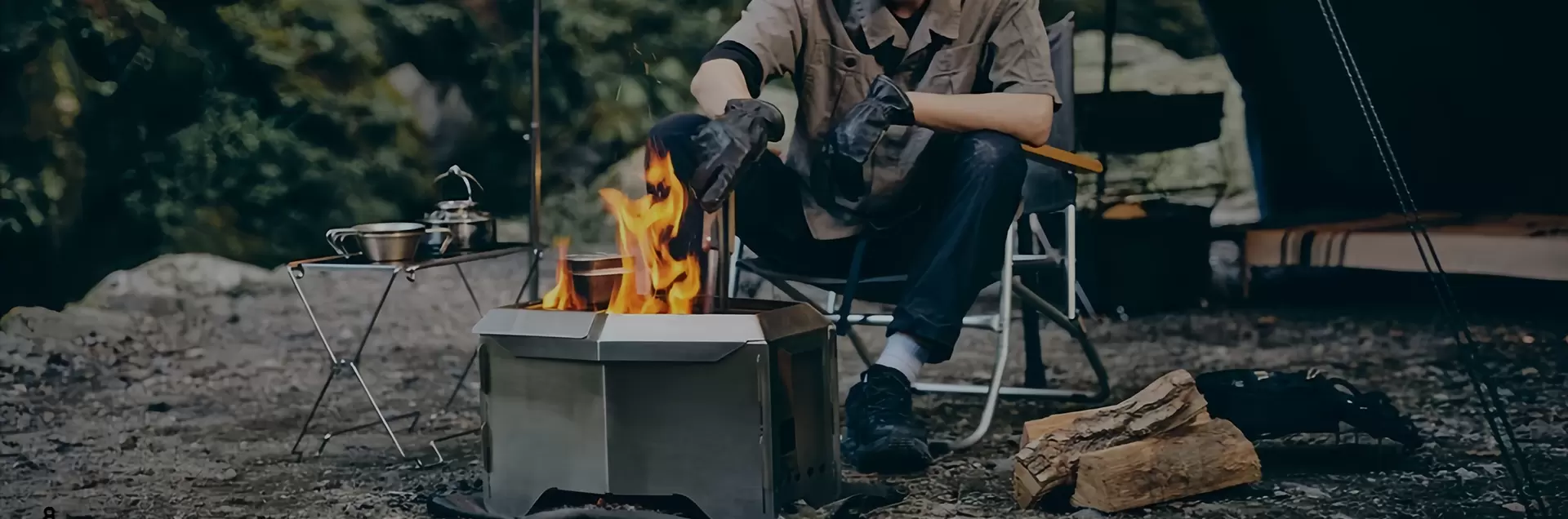

 RELATED MAGAZINE







 Leave a Message