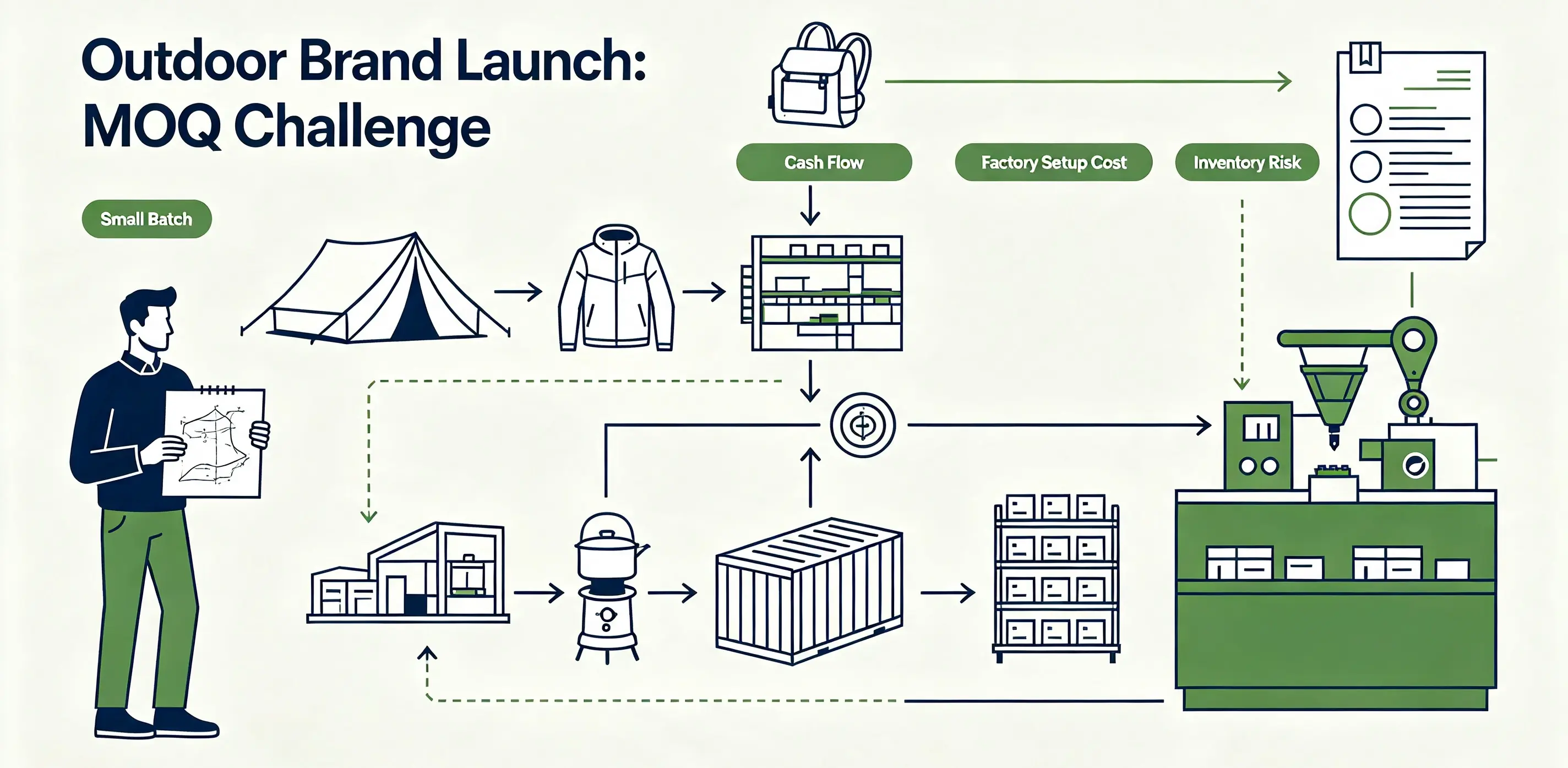
Launching an outdoor brand is an exhilarating journey, but startup founders quickly encounter a major operational roadblock: the Minimum Order Quantity (MOQ). Whether you are developing technical apparel, camping stoves, or specialized backpacks, factory MOQs can strain early-stage capital and stall product launches.
Navigating supplier relationships requires understanding why factories set these thresholds and how to negotiate terms that protect your cash flow. This guide provides actionable strategies for startup founders, product managers, and procurement teams to decode factory MOQs, mitigate inventory risks, and build sustainable manufacturing partnerships.
Introduction: Why MOQs are the Biggest Hurdle for Outdoor Startups
Minimum Order Quantity (MOQ) represents the lowest number of units a manufacturer is willing to produce in a single production run. In the outdoor hardware and technical apparel industries, factory MOQs frequently range from 500 to 3,000 units per style.
This creates a fundamental conflict for early-stage outdoor brands:
The Startup Dilemma: Founders need to test the market with small batch runs while conserving cash flow.
The Factory Requirement: OEM/ODM factories demand large production volumes to justify operational expenses.
Bridging this gap requires strategic negotiation, smart product design, and a clear understanding of factory economics.
Understanding Factory Economics: Why OEM/ODM Manufacturers Set High MOQs
Factories do not set high MOQs to discourage small brands. Rather, these thresholds are rooted in operational break-even math.
Setup and Tooling Costs: Every time a factory switches production from one product to another, technicians must recalibrate machinery, install new molds, and reconfigure assembly lines. These setup costs represent non-billable downtime.
Efficiency and Scrap Rates: Assembly line workers achieve peak efficiency after repeating a process hundreds of times. Small production runs suffer from lower productivity and higher material scrap rates during calibration.
Break-Even Realities: A factory must produce a minimum volume per run to cover overhead, supervisor salaries, and electricity costs while maintaining a modest profit margin.
Dissecting the Two Types of MOQs: Product MOQs vs. Material MOQs
When a supplier quotes a high MOQ, it is crucial to determine where the bottleneck actually originates.
Product MOQ: The minimum assembly volume required by the primary OEM/ODM factory to run their finished-goods line.
Material and Component MOQ: The minimum order volume imposed by tier-2 suppliers (such as waterproof membrane mills, custom zipper suppliers, or buckle manufacturers).
In many cases, an OEM factory might be willing to assemble 200 units, but their fabric mill requires a minimum dye run of 1,500 meters. The finished product MOQ is often dictated by raw material constraints rather than factory assembly limits.
Strategic Negotiation Tactics to Lower Initial MOQs
Procurement teams can use several proven negotiation levers to convince factories to accept smaller initial orders:
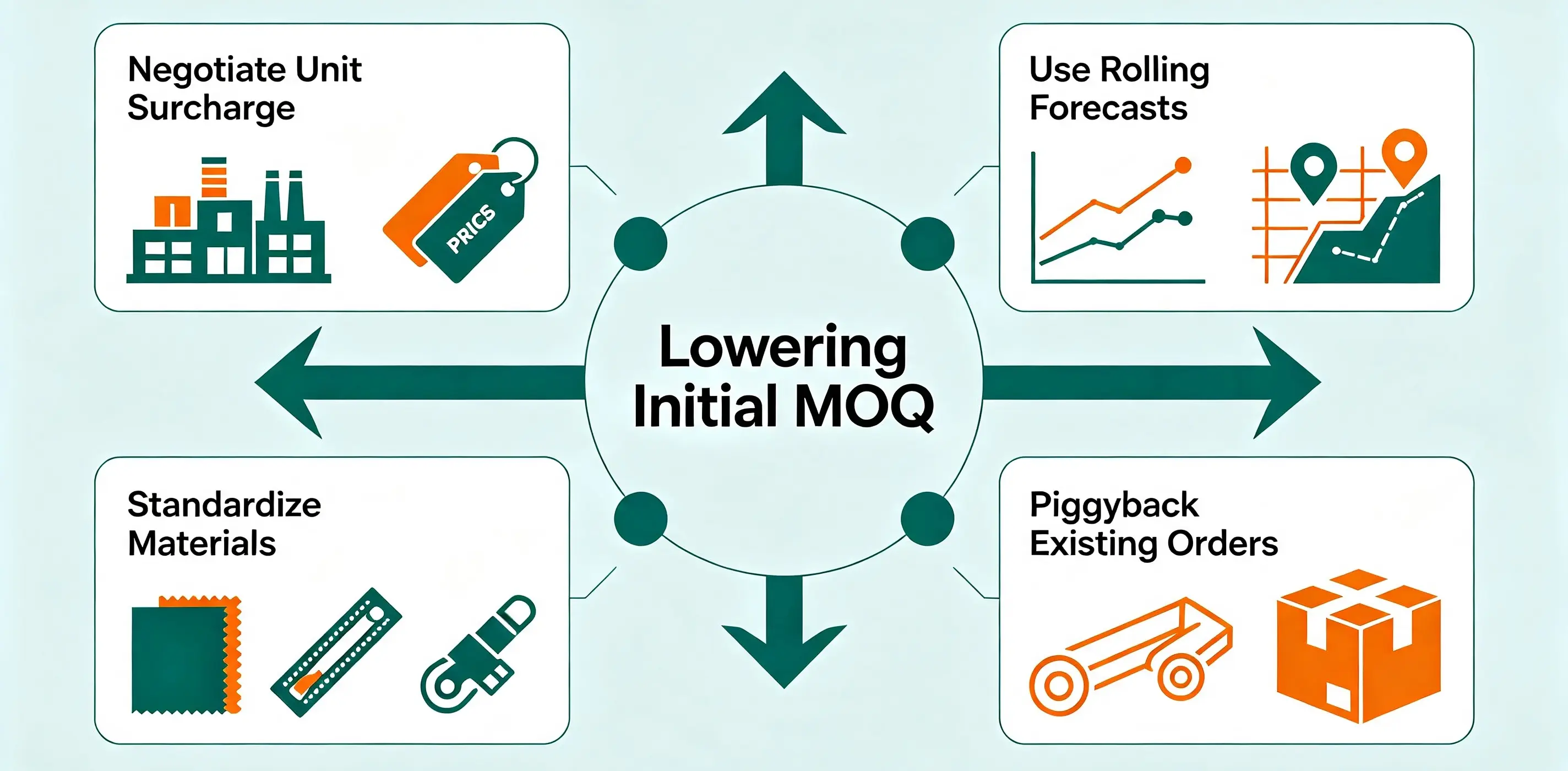
Pay a Unit Surcharge: Offer to pay a 15% to 30% price premium on the first small production run. This surcharge offsets the factory's setup costs while allowing you to validate the market with minimal inventory risk.
Provide Rolling Forecasts: Present a professional 12-to-18-month product roadmap and rolling purchase forecast. Demonstrating long-term growth potential encourages factories to view your initial small order as an investment.
Schedule During Off-Peak Months: Offer to run your production during the factory's low season when assembly lines are underutilized, giving them an incentive to accept flexible MOQs.
Product Standardization and Modular Design: Design for Low MOQ
Smart product design directly lowers manufacturing barriers. Designing for low MOQs involves streamlining materials and hardware across your catalog.
Use In-Stock Materials and Hardware: Choose standard, off-the-shelf fabric colors and standard hardware trims rather than requesting custom Pantone color dyeing or unique metal alloys.
Streamline SKUs and Colorways: Launch your brand with 1 or 2 versatile colorways instead of spreading your initial order volume across multiple variants.
Post-Customization Strategy: Utilize standard base product bodies and create brand differentiation through custom patches, screen-printed logos, unique hangtags, and custom retail packaging.
Co-sourcing and Piggybacking: Leveraging Existing Factory Production
Startups can ride the momentum of established brands to achieve smaller batch runs.
Piggybacking on Existing Materials: Ask your factory what fabrics or components they are currently purchasing in bulk for major clients. By selecting the same materials, you eliminate tier-2 material MOQs.
Co-sourcing Non-Competitive Hardware: Partner with non-competing outdoor brands to jointly order shared components, such as custom buckles, tent poles, or standard zippers.
Target Mid-Sized, Growing Factories: Avoid Tier-1 mega-factories that prioritize massive enterprise accounts. Instead, partner with agile, mid-sized manufacturers seeking long-term growth partners.
Working with Sourcing Agents vs. Direct Factory Relationships
Deciding how to interface with suppliers impacts both MOQs and operational complexity.
Sourcing Agents and Trading Companies: Agents consolidate small orders from multiple buyers, giving them the collective leverage needed to negotiate low MOQs with factories. They also manage quality control and local communication.
Direct-to-Factory Relationships: Working directly with factories cuts out intermediary margins but requires higher volume commitments, internal procurement expertise, and greater risk management.
Strategic Roadmap: Utilize sourcing agents during your launch phase to access low MOQs, then transition to direct factory relationships as volume scales.
Financial Strategies for Managing MOQ Cash Flow Risks
Managing cash flow is essential when meeting supplier volume requirements.
Optimize Payment Terms: Negotiate a standard payment structure of 30% deposit upfront and 70% due upon pre-shipment quality inspection approval, avoiding 100% advance payments.
Leverage Pre-Orders and Crowdfunding: Use platforms like Kickstarter or direct-to-consumer pre-orders to validate demand and generate upfront capital before committing to factory production runs.
Analyze Dead Stock Costs: Avoid ordering larger quantities solely to achieve a cheaper per-unit cost. Holding excess unsold inventory in a warehouse ties up capital and incurs storage fees that quickly erase production savings.
Red Flags to Avoid When Negotiating Low MOQs with Suppliers
Pushing suppliers too hard on low MOQs can backfire if you don't monitor quality and compliance carefully.
Quality Degradation: Be cautious if a supplier casually agrees to a low MOQ without adjusting unit pricing. Factories may cut corners on raw materials, skip quality inspections, or assign inexperienced line workers.
Uncertified Facilities: Avoid unaccredited sub-factories that lack international safety certifications, ethical labor audits, or consistent quality control processes.
Hidden Surcharges: Ensure quotes explicitly outline all setup fees, mold charges, sample costs, packaging surcharges, and export documentation fees before placing deposits.
Conclusion: Scaling Your Outdoor Brand Step-by-Step
Overcoming factory MOQs requires a strategic balance of financial planning, smart product design, and collaborative supplier relationships. Rather than viewing factories as mere vendors, treat them as strategic long-term partners.
By starting lean, focusing on versatile core SKUs, and leveraging clever sourcing tactics, startup founders can successfully navigate initial manufacturing hurdles and scale their outdoor brands sustainably.
Frequently Asked Questions
What is a typical MOQ for outdoor gear and apparel manufacturing?
Typical MOQs vary significantly by product category. Outdoor technical apparel generally requires 300 to 500 units per style/color (driven primarily by fabric dye-lot minimums). Complex gear like backpacks or camping tents usually requires 200 to 500 units, while portable stoves or metal hardware components typically range from 500 to 1,000 units.
Can I negotiate a lower MOQ if I offer to pay a higher price per unit?
Yes. Factories establish MOQs to ensure a production run generates enough gross profit to cover line setup and administrative costs. Offering to pay a 15% to 30% unit surcharge for smaller order volumes allows the factory to maintain profitability while giving you the flexibility to order smaller test quantities.
How do suppliers handle custom colors versus stock fabric colors?
Ordering custom Pantone-dyed fabrics requires meeting tier-2 mill dyeing minimums (typically 1,000 to 3,000 meters). Conversely, choosing standard in-stock factory colors bypasses raw material minimums, allowing suppliers to drop finished-goods product MOQs to as low as 50 to 100 units.
What should I do if a factory refuses to compromise on high MOQs?
If a manufacturer refuses to lower their MOQ, consider three alternatives:
Source off-the-shelf blank products and customize them via secondary printing, embroidery, or custom trims.
Partner with a specialized sourcing agent who consolidates small buyer orders.
Reduce your overall SKU count and concentrate your initial budget into a single flagship product to satisfy the factory requirement.


 en
en ja
ja ko
ko zh
zh es
es ru
ru fr
fr ar
ar pt
pt tr
tr nl
nl it
it de
de

 RELATED MAGAZINE







 Leave a Message