Introduction: The Brutal Test of Extreme Cold on Tent Stove Materials
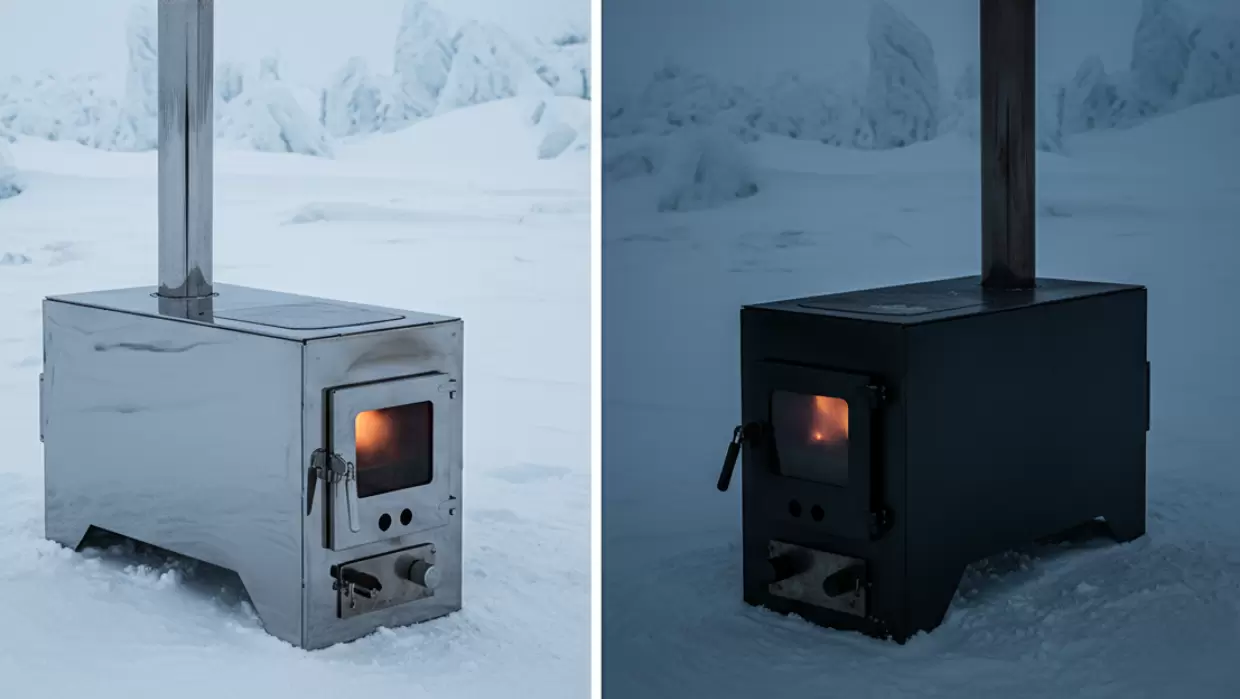
In sub-zero wilderness conditions reaching -20°C or lower, a winter tent stove transitions from a recreational comfort into critical survival gear. Choosing the wrong hardware can lead to catastrophic structural failure when intense internal firebox temperatures meet freezing ambient air. This brings procurement managers and outdoor brands to the ultimate metallurgical showdown in the manufacturing market: 304 stainless steel tent stove designs versus the traditional, heavy-duty carbon steel wood stove.
To help your brand optimize its sourcing strategy and select the right inventory, this analysis delivers a data-driven breakdown of both materials. We will deeply evaluate how these two foundational metals perform as an extreme cold camping heater, examining their real-world thermal efficiency, long-term durability, and structural resistance to high-temperature warping on the factory floor and in the field.
Core Data Showdown: 304 Stainless Steel vs. Carbon Steel Performance Matrix
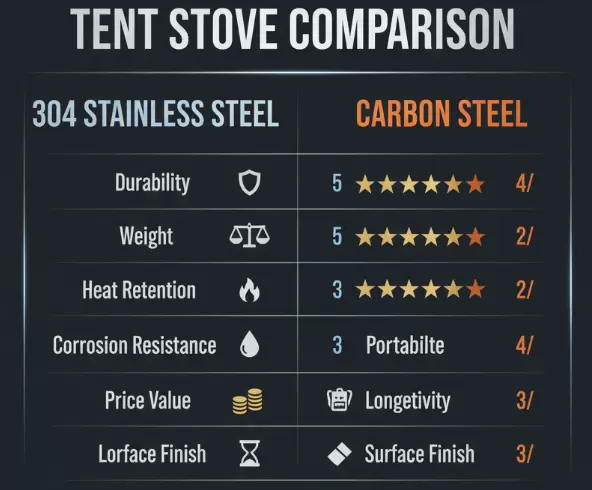
When optimizing your supply chain for an extreme cold camping heater, relying on marketing descriptions is insufficient. Product engineers and B2B procurement managers require raw, empirical data to evaluate how a 304 stainless steel tent stove compares to a heavy-duty carbon steel wood stove.
The metallurgical matrix below outlines the fundamental physical and mechanical properties that dictate factory fabrication costs and real-world winter performance.
Material Property Comparison Matrix
| Performance Dimension | 304 Stainless Steel (Thin Gauge: 1.0mm–1.5mm) | Carbon Steel / Black Steel (Thicker Gauge: 1.5mm–2.5mm) |
| Thermal Conductivity | Lower (~16 W/m·K) — Slower, localized heat distribution | Higher (~50 W/m·K) — Rapid, uniform radiant heat |
| Thermal Mass (Heat Retention) | Low — Cools down quickly once the fire dies | High — Retains and radiates heat long after embers fade |
| Max Continuous Temperature | High (~800°C) — Resists structural scaling and breakdown | Moderate (~450°C) — Rapidly oxidizes without protective coatings |
| Corrosion Resistance | Excellent — High chromium content prevents rust from snowmelt | Poor — Requires high-temperature paint; prone to rust in damp environments |
| High-Temp Warping Resistance | Moderate — High thermal expansion coefficient requires structural ribs | High — Low thermal expansion coefficient keeps thick panels stable |
| Baseline Material Unit Cost | Higher — Premium alloy pricing | Lower — Cost-effective raw material sourcing |
Key Sourcing Conclusions
Supply Chain Insight: In extreme cold wilderness environments, a carbon steel wood stove leverages its superior thermal mass to deliver more stable, overnight slow-burn heat retention, making it an excellent budget-friendly shelter heater. Conversely, a 304 stainless steel tent stove demonstrates a dominant longevity advantage due to its absolute resistance to long-term high-temperature oxidation and corrosive winter snowmelt, making it the preferred premium choice for global outdoor brands.
Deep Dive into the 304 Stainless Steel Tent Stove: The Rust-Resistant Standard of Modern Manufacturing

As global outdoor brands upgrade their product lineups to meet premium winter requirements, the 304 stainless steel tent stove has become an industry benchmark for clean, low-maintenance performance. For B2B procurement managers, understanding the underlying metallurgy of this material is essential for justifying its higher upfront cost over carbon steel variants.
Core Advantage: Uncompromising Anti-Oxidation and Snowmelt Corrosion Resistance
The primary commercial appeal of 304-grade stainless steel lies in its chemical composition. It is an austenitic alloy containing a minimum of 18% chromium and 8% nickel.
The Passive Oxide Layer: When exposed to oxygen, the chromium within the alloy immediately forms an invisible, self-healing chromium oxide film on the metal's surface. This passive layer isolates the underlying steel from atmospheric moisture and volatile combustion byproducts.
Zero-Rust Performance in Basecamps: Winter hot-tenting environments are notoriously damp. When hot exhaust gases hit sub-zero external air, massive amounts of corrosive condensation form inside the firebox and chimney. Standard steels corrode rapidly under these conditions, but 304 stainless steel remains completely immune to rust triggered by melting snow, rain, and acidic wood creosote.
Low Maintenance Overhead: For international distributors and retail consumers, this rust immunity translates to an exceptionally low lifetime maintenance cost. Stoves can be packed away wet during a storm without the risk of seizing joints or structural degradation, significantly reducing warranty return rates for your brand.
The Extreme Cold Paint Point: Rapid Heat Dissipation and High-Temperature Warping Risks
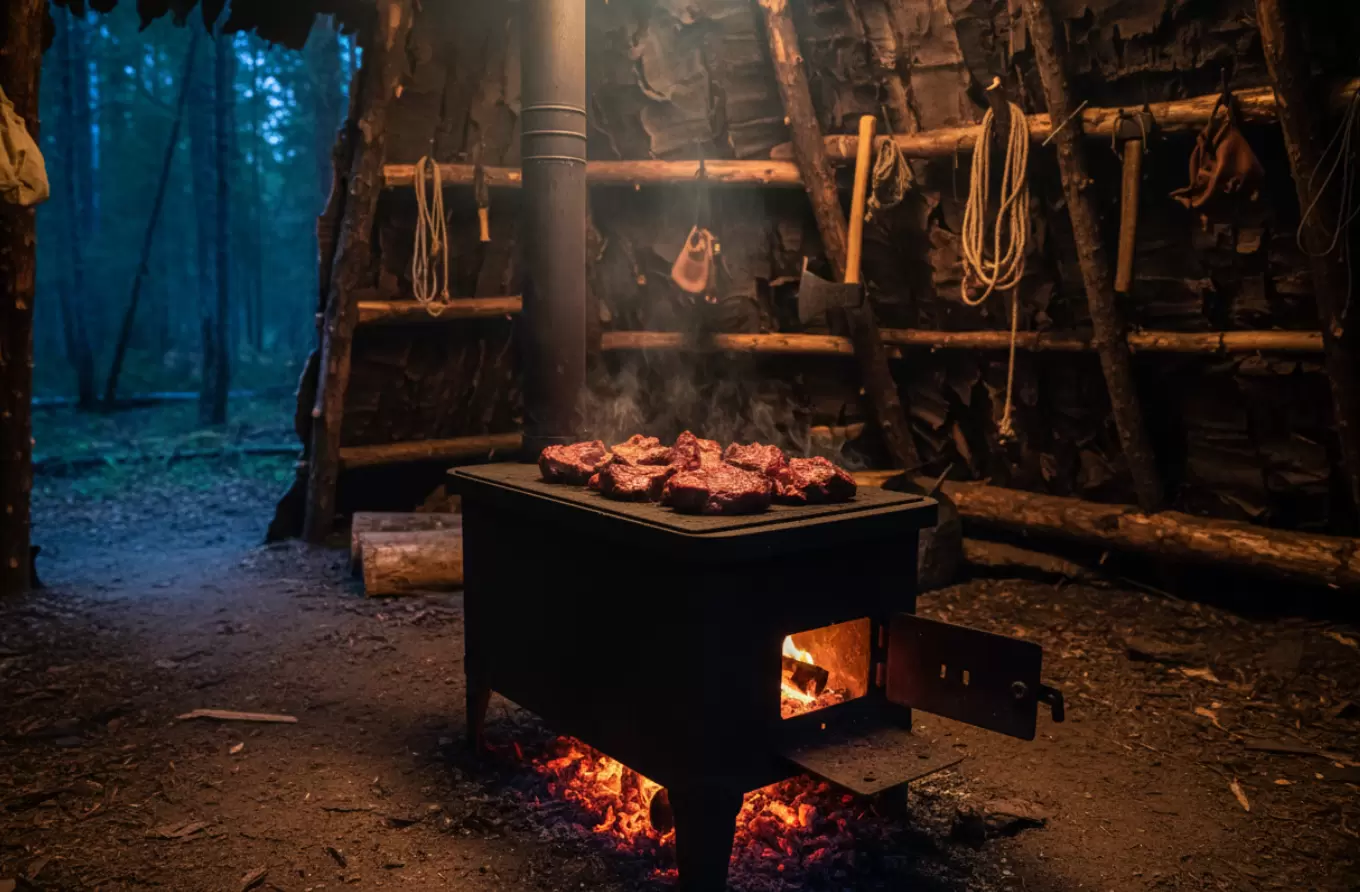
Despite its dominant corrosion resistance, utilizing 304 stainless steel in an extreme cold camping heater introduces specific thermodynamic and structural challenges that OEM engineers must actively mitigate.
The "Flash-Cooling" Effect: While austenitic stainless steel has a lower thermal conductivity coefficient than carbon steel, factories frequently fabricate stainless stoves using thinner gauges (typically 1.0mm to 1.2mm) to save weight for the backpacking market. Because the material mass is low, these thin panels transfer heat quickly but lack thermal inertia. The moment the wood fuel burns down, the stove suffers immediate heat loss, dropping to freezing ambient temperatures almost instantly.
Thermal Stress Distortion: The most critical engineering vulnerability of thin-gauge 304 stainless steel is its high coefficient of thermal expansion. In a winter setting, the interior of the firebox can rapidly soar past 650°C, while the exterior facing panels are exposed to sudden gusts at -20°C. This radical temperature delta creates violent localized thermal stresses.
The Thickness Threshold: If the structural sheet thickness drops below 1.5mm and lacks integrated 3D reinforcement ribs, the metal panels will inevitably buckle, warp, or twist. This structural distortion can compromise the flush alignment of folding seams, creating micro-gaps that allow toxic gases to leak.
For high-standard OEM camp stove manufacturing, countering this physical limitation requires integrating precision-stamped anti-warping ridges or upgrading the load-bearing frame panels to a sturdier 1.5mm threshold to ensure fail-safe operation in the field.
Deep Dive into the Carbon Steel Tent Stove: The Thermal Mass King for Bushcraft Enthusiasts and Basecamps
While stainless steel dominates the modern ultralight market, the traditional heavy-duty carbon steel wood stove remains the uncontructured favorite among traditional bushcraft (BC) veterans and permanent winter basecamp operators. For B2B buyers, understanding why this heavier material choice maintains a loyal market share is crucial for balancing a diverse winter product portfolio.
1. Core Advantage: Incredible Thermal Mass and Stable Radiant Heat Output
The primary commercial value of a carbon steel stove lies entirely in its superior thermodynamic profile. Unlike ultralight models, commercial carbon steel stoves are fabricated using thick-gauge plates, typically ranging from 2.0mm to 2.5mm or thicker.
High Thermal Mass Retention: In physics, thermal mass refers to a material’s capacity to absorb, store, and slowly release heat energy. Because a carbon steel chassis contains significantly more physical metal mass per square centimeter than a thin 1.0mm stainless steel alternative, it acts as a highly efficient thermal reservoir.
Stable Infrared Radiation: Once the firebox is fully heated, carbon steel does not simply vent heat; it flattens out volatile temperature spikes caused by fluctuating fire wood combustion. It continuously radiates a deep, uniform, and comfortable long-wave infrared heat across large wall tents.
The Overnight Slow-Burn Advantage: The ultimate field benefit occurs during the late-night burn cycle. When the primary wood fuel collapses into coals and embers, a thin-gauge stove cools down almost instantly. A thick carbon steel stove, however, retains its internal energy, radiating residual warmth into the shelter for hours after the fire has died down—providing critical protection against overnight hypothermia in extreme cold camping heater applications.
2. The Critical Vulnerability: High-Frequency Maintenance Demands and Aggressive Iron Oxidation
Despite its elite thermal output, carbon steel introduces massive supply chain and consumer maintenance challenges due to its lack of inherent corrosion resistance.
The Rust Catalyst: Unalloyed carbon steel contains no chromium to form a protective oxide barrier. In a hot tent environment, the metal is constantly exposed to a volatile cocktail of melting snow, external rain, and heavy internal moisture condensation. Without strict care, the iron rapidly reacts with oxygen and water, leading to aggressive iron oxide (rust) formation that can structurally compromise the firebox seams.
Reliance on High-Temperature Paint: To protect the metal during transit and early field use, OEM camp stove manufacturing facilities must apply specialized, industrial-grade high-temperature paint (typically silicone-based coatings rated up to 600°C–800°C). However, under intense direct flame contact, these coatings will eventually blister, cure out, or flake off over multiple heating cycles.
Sourcing Insight for Brands: Because carbon steel requires immediate post-trip maintenance—including thorough drying, soot removal, and a complete wipe-down with anti-corrosion or mineral oils after every single excursion—it carries a higher consumer learning curve. If your target market consists of casual campers, thin stainless steel or titanium is a safer retail bet. However, if your brand targets hardcore wilderness guides, traditional outfitters, and bushcraft specialists, a rugged carbon steel model offers an unyielding heat profile that thin alloys simply cannot replicate.
Structural Challenges Under Extreme Temperature Differentials: Which Resists "Warping" Better?
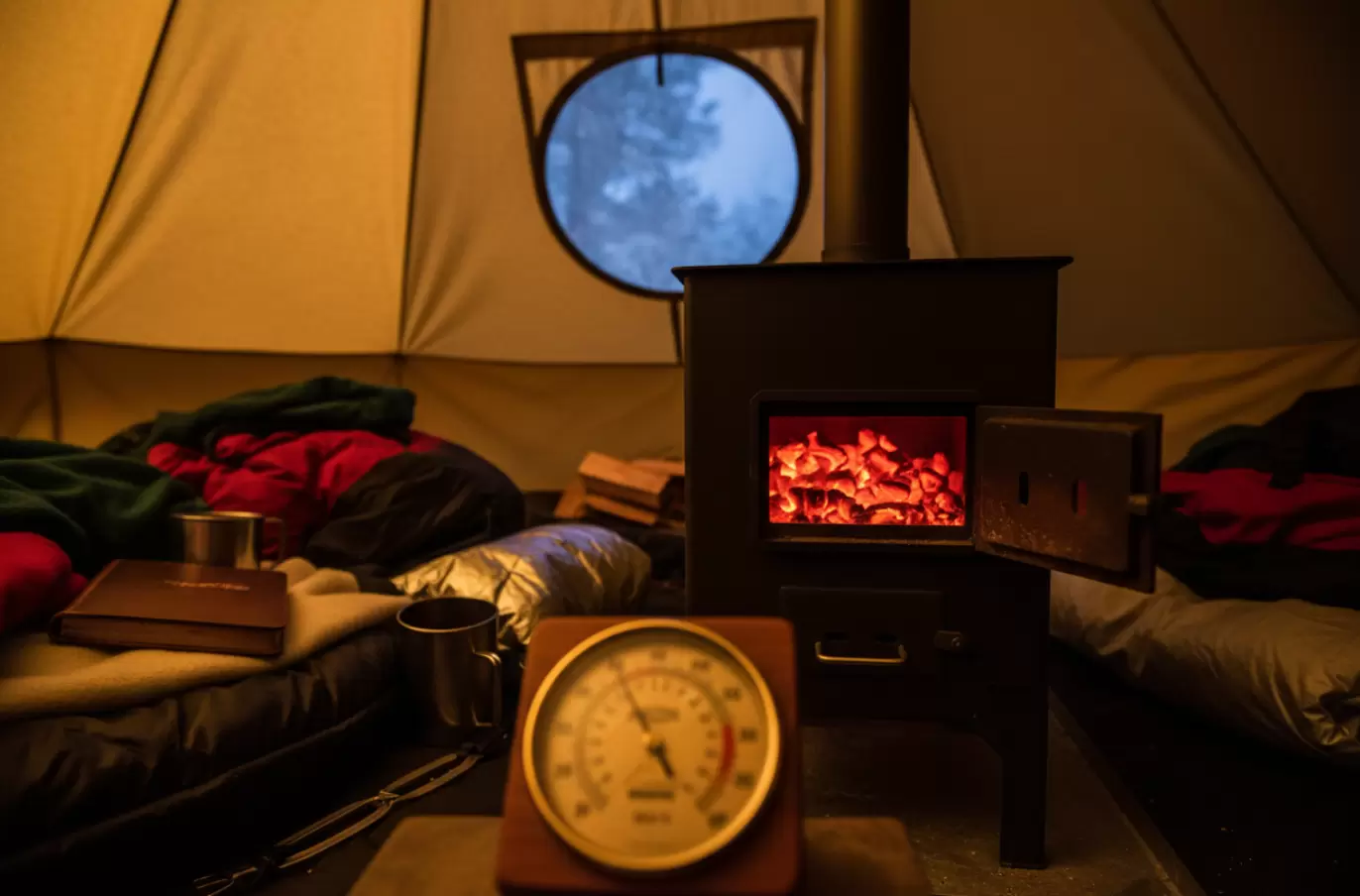
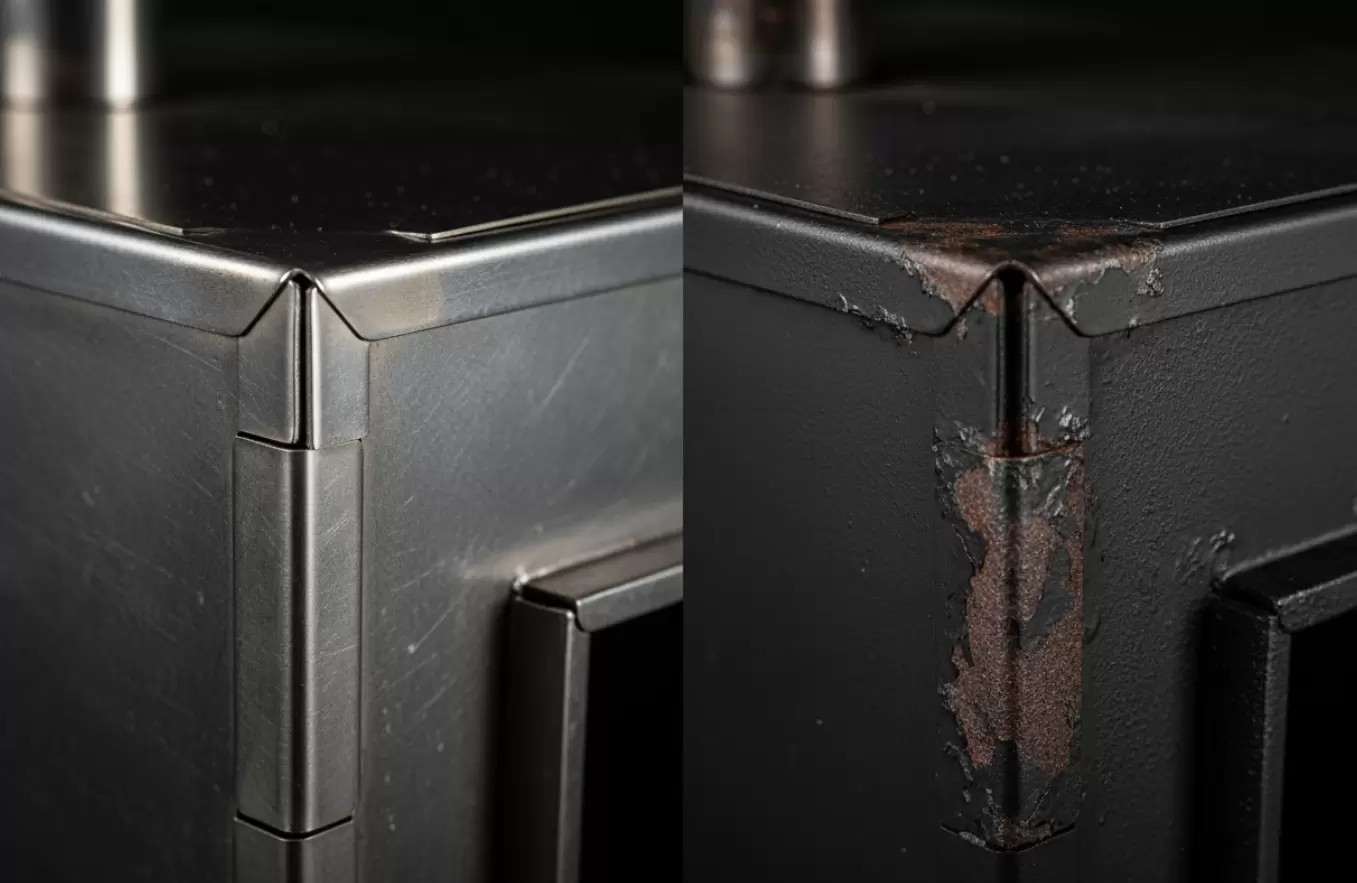
From a materials mechanics perspective, operating an extreme cold camping heater subjects the metal chassis to volatile thermodynamic shock. When the outer walls of a roaring firebox are suddenly struck by freezing snowmelt or sub-zero mountain winds while the inner chamber exceeds 600°C, a severe thermal gradient is established. This radical delta triggers differential expansion across the metal's crystalline structure, leading to structural deformation, buckling, or permanent "warping."
Carbon Steel: High Thickness and Massive Mechanical Rigidity
A heavy-duty carbon steel wood stove possesses an inherent mechanical advantage against warping, primarily due to its standard manufacturing gauge. Because these units are typically fabricated from thick-gauge sheets (2.0mm to 2.5mm), the absolute cross-sectional rigidity is incredibly high. Carbon steel also features a significantly lower coefficient of thermal expansion compared to stainless steel alloys. This means the metal moves less drastically when heated, allowing the firebox to maintain its true lines and tight panel junctions even under prolonged, maximum-output burns.
304 Stainless Steel: The Critical Need for Anti-Deformation Engineering
Conversely, an unreinforced 304 stainless steel tent stove faces a much higher risk of structural distortion. Thinner gauges (1.0mm to 1.2mm) combined with stainless steel’s high thermal expansion rate create a volatile combination for metallurgical stress. As localized hot spots expand faster than the cooler surrounding edges, the thin sheet metal experiences "oil-canning"—a warping phenomenon that permanently buckles the panels
B2B Sourcing Strategy: When sourcing stainless steel inventory, procurement managers must carefully evaluate the factory's anti-warping DFM (Design for Manufacturing) craftsmanship. Avoid flat, unreinforced thin-gauge stainless steel panels. Ensure your OEM manufacturer integrates 3D stamped reinforcement ribs, progressive multi-fold borders, or independent interlocking structural support brackets. These engineering features actively redistribute thermal stress, preventing gas-leaking micro-gaps and securing long-term field reliability for end-users.
The Ultimate Overnight Burn Showdown: Which Stove Keeps Campers Warm Until Dawn?
When outfitting a winter expedition, evaluating an extreme cold camping heater for its raw thermal output is only half the battle. For end-users surviving sub-zero nights, the definitive metric of quality is overnight heating efficiency. A stove must be capable of maintaining a safe, continuous heat cycle so campers do not wake up freezing in the middle of the night to reload the firebox.
Squeezing the Air: The "Dampened Down" Operational Logic
To achieve an extended burn time through the night, users rely on precise airflow management. Once a robust bed of coals is established, the primary intake valves and chimney dampers are aggressively choked—or dampened down—to restrict oxygen supply. This slows down the wood consumption rate, shifting the firebox from an active, open flame into a prolonged, low-oxygen smolder.
Carbon Steel: The 6-to-8-Hour Infrared Radiator
Under these dampened conditions, a heavy-gauge carbon steel wood stove delivers peak performance. Because the thick-gauge metal (2.0mm+) possesses high thermal mass, it acts as a massive thermal battery:
Residual Heat Bonus: Even when wood gasification slows to a crawl, the thick steel absorbs the energy from the coals, continuously radiating deep, stable infrared warmth into the shelter.
Extended Window: This thermodynamic profile guarantees a reliable 6 to 8 hours of steady heat output, flattening out temperature drops and ensuring camp comfort until sunrise.
304 Stainless Steel: Fuel-Dependent Heat Cycles
Conversely, an ultralight 304 stainless steel tent stove struggles in a true overnight low-smolder scenario. Because these chassis are optimized for weight reduction and feature much thinner walls (typically 1.0mm to 1.2mm), they lack the physical mass required to store heat.
Zero Thermal Buffering: A stainless steel stove is almost entirely dependent on the immediate flame of the fuel itself.
The Cool-Down Curve: The moment the active wood flame dies down into embers, the thin alloy dissipates its remaining energy instantly, resulting in a rapid drop to ambient freezing temperatures inside the tent.
Procurement Insight: If your brand is developing stoves for the heavy-duty glamping, outfitter, or hunting sectors where extended overnight heating is a non-negotiable purchasing driver, thick carbon steel remains highly competitive. However, if you are targeting the mobile backpacking market with stainless steel variants, your DFM engineering must focus on optimizing air-tight damper seals to maximize fuel efficiency and stretch the fuel's active burn time as much as physically possible.
Long-Term Maintenance and Lifespan: High-Temperature Oxidation Resistance vs. Rust Prevention
When evaluating the long-term Total Cost of Ownership (TCO) over a 2-to-3-year field operational window, the structural divergence between these two metals becomes highly pronounced, directly impacting warranty return rates and brand equity.
304 Stainless Steel: Micro-Level Grain Shift, Zero Flaking
Continuous exposure to localized core combustion temperatures reaching 700°C can induce minor intergranular corrosion within 304 stainless steel. This occurs as chromium carbides precipitate at the grain boundaries under sustained heat.
However, from an industrial standpoint, this metallurgical shift progresses at a negligible pace. The overall chassis structurally resists material peeling, meaning the stove walls maintain their original factory gauge thickness and do not thin down or degrade over years of intense seasonal use.
Carbon Steel: The Risk of Progressive Wall Thinning
Conversely, a carbon steel firebox faces a much more aggressive degradation timeline if consumer maintenance slips. When unprotected iron is subjected to alternating moisture and high heat, it undergoes rapid oxidation, leading to severe surface flaking (scaling).
As layers of iron oxide repeatedly form and peel away, the load-bearing stove walls thin progressively year over year. If left unchecked, this scaling cycle inevitably leads to localized structural burn-through, destroying the unit's airtight integrity.
B2B Manufacturing Requirement: To eliminate this field liability, high-tier OEM camp stove manufacturing facilities must implement rigorous surface chemistry protocols. Before applying a high-temperature silicone topcoat, the raw carbon steel must undergo an advanced manganese or zinc phosphating pre-treatment. This industrial conversion coating creates a highly micro-porous crystalline layer that chemically anchors the heat-resistant paint, preventing premature blistering, delaying oxidation, and significantly extending the product's commercial lifespan.
B2B/OEM Manufacturing Viewpoint: Work Hardening, Welding Difficulty, and Production Cost Amortization
For international sourcing directors and product engineers evaluating OEM camp stove manufacturing options, a product’s commercial success depends heavily on factory floor execution. Choosing between a 304 stainless steel tent stove and a carbon steel wood stove involves more than assessing field performance—it requires a deep look at mechanical fabrication, tooling lifecycles, and production cost margins.
304 Stainless Steel: High Tooling Overhead and Precision Metallurgical Demands
Fabricating with 304-grade stainless steel introduces specific engineering challenges during high-volume production:
Work Hardening Characteristics: Austenitic stainless steel hardens rapidly under mechanical deformation. During high-speed CNC progressive stamping or deep-drawing processes, this material property accelerates wear on cutting dies, increasing tooling maintenance and amortization costs.
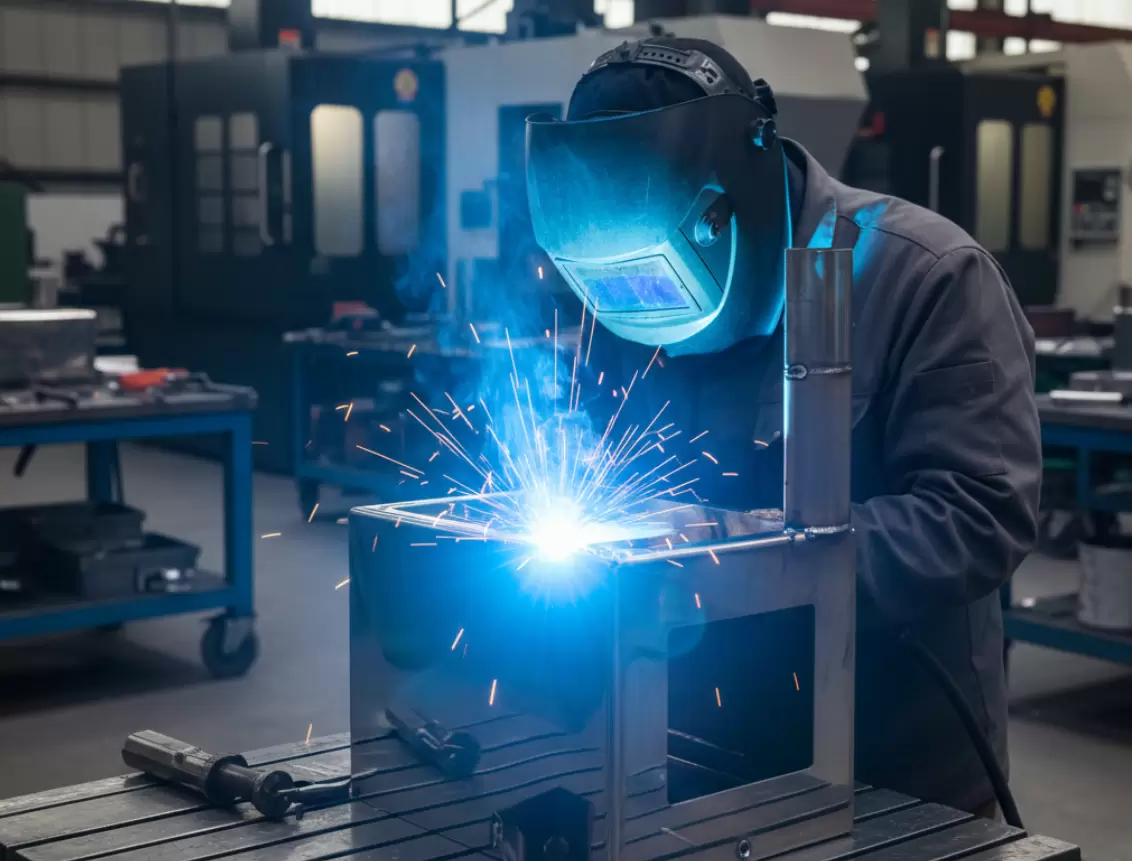
Complex Welding and Fixturing: Achieving airtight joints requires specialized TIG welding (Tungsten Inert Gas). Because stainless steel expands aggressively under heat, factories must deploy custom-engineered, heavy-duty anti-deformation jigs to hold the chassis in alignment, which extends cycle times and limits overall production throughput.
Carbon Steel: Optimized Machinability and Scalable Cost Margins
Conversely, carbon steel is highly optimized for mass production and maximum factory efficiency:
Excellent Machinability: Carbon steel cuts cleanly with minimal tool wear, maximizing the lifespan of precision stamping and laser cutting hardware.
Mature Welding Logistics: Standard automated robotic MIG or laser welding lines easily handle carbon steel without complex thermal clamping setups, significantly increasing daily factory yields.
B2B Procurement Bottom Line: Due to lower raw material premiums, faster assembly cycles, and reduced tooling wear, the total manufacturing cost of a carbon steel stove is 20% to 35% lower than a 304 stainless steel model with identical dimensions. Sourcing carbon steel allows brands to capture higher gross margins or enter the market with a highly competitive retail price point.
Decision Matrix: Choosing the Right Stove for Your Winter Camping Profile
To maximize retail conversions or streamline your procurement strategy, matching hardware specifications with the end-user's exact operational scenario is critical. Use this definitive, scenario-driven decision matrix to determine your ideal product alignment for the upcoming winter season:
For Car Camping, Overlanding, and Long-Term Basecamp Heavy Users: Select a heavy-duty carbon steel wood stove. This thick-gauge configuration is optimized for stationary setups where weight is secondary to survival performance, allowing users to enjoy unmatched heat capacity and continuous, deeply penetrating infrared radiation that keeps the tent warm all night long.
For Wet Environments, Low-Maintenance Preferences, and Mobile Minimalist Campers: Select a folding or semi-folding 304 stainless steel tent stove. This lightweight, highly packable configuration is engineered for users who frequently encounter heavy rain or melting snow and want a hassle-free, grab-and-go heating solution backed by absolute, lifetime rust immunity.
Conclusion: The Metallurgical Iron Law for Extreme Cold Environments in 2026
In the highly competitive winter outdoor hardware sector, there is no single flawless material—only optimized engineering solutions tailored to specific wilderness scenarios. As we analyze the latest 2026 outdoor manufacturing trends, premium gear design is rapidly shifting toward innovative composite material architectures. By strategically merging a heavy-gauge carbon steel firebox base for unmatched heat retention with a high-grade 304 stainless steel tent stove upper chassis for superior corrosion resistance, factories are engineering the ultimate hybrid systems.
For global B2B distributors and outdoor brand managers, maximizing market share requires a highly rationalized supply chain strategy. Sourcing decisions must balance the target region's climate realities against consumer price point expectations. Whether you invest in the rugged, high-thermal mass performance of a traditional carbon steel wood stove or the zero-maintenance convenience of advanced stainless steel, aligning with a sophisticated OEM partner capable of executing these precise material geometries is the definitive key to securing your brand's competitive edge.
Frequently Asked Questions: Advanced Metallurgy and Sourcing Logistics
Q1: Is a 304 stainless steel stove truly more prone to warping than a carbon steel stove in extreme cold down to -20°C?
A: This vulnerability depends heavily on panel thickness and structural engineering rather than the material alone. If compared at identical thin gauges (such as 1.0mm), a 304 stainless steel tent stove is more susceptible to localized buckling because it possesses a significantly higher coefficient of thermal expansion than carbon steel. When subjected to severe thermal gradients—where the interior firebox is a roaring furnace and the exterior panels are exposed to sub-zero alpine winds—the metal shifts aggressively.
However, premium modern manufacturers have largely neutralized this physical limitation. High-quality stainless steel stoves are engineered with stamped anti-warping ribs, multi-folded borders, or three-dimensional interlocking seams that redistribute thermal stress, ensuring structural integrity even in volatile climates.
Q2: Does the high-temperature protective coating on a carbon steel wood stove release toxic fumes inside a tent when it degrades?
A: No, provided the hardware is sourced from a reputable, certified OEM/ODM facility. Top-tier manufacturers finish their carbon steel stoves with professional-grade, inorganic high-temperature silicone paint. These specialized industrial coatings are designed to undergo a critical "burn-in" cycle during their first operational fire (which should always be performed outdoors).
During this initial firing, all volatile organic compounds (VOCs) and chemical solvents are completely vaporized and cured out. In subsequent wilderness deployments, even if the coating eventually blisters or flakes away due to extreme localized heat, the exposed metal will only undergo standard physical iron oxidation (rusting). It will not release toxic chemical vapors or hazardous industrial gases into the living space.
Q3: From a B2B procurement and logistics perspective, which material holds the stronger supply chain advantage?
A: The answer depends on how your brand balances initial manufacturing costs against global shipping overhead.
The Landed Cost Advantage (304 Stainless Steel): If your primary supply chain bottleneck is overseas freight, custom duties, and warehousing volume, 304 stainless steel folding stoves offer an overwhelming advantage. Because stainless steel can be fabricated in ultra-thin gauges without sacrificing structural integrity, these units are typically designed as modular, flat-packed assemblies. This drastically reduces the total cubic meter (CBM) container volume and total weight, lowering cross-border logistics costs.
The FOB Price Advantage (Carbon Steel): If you are prioritizing the raw FOB factory price, a carbon steel wood stove is highly competitive. Carbon steel requires significantly lower raw material premiums and features exceptional machinability, which reduces tooling wear and accelerates factory output. However, because carbon steel requires thick-gauge plates (2.0mm–3.0mm) to prevent warping, these units are often shipped as heavy, fully welded or rigid semi-folding configurations that consume massive amounts of shipping volume.
International purchasing managers must evaluate the comprehensive "factory-to-warehouse" matrix to calculate the optimal landed cost for their specific regional markets.


 en
en ja
ja ko
ko zh
zh es
es ru
ru fr
fr ar
ar pt
pt tr
tr nl
nl it
it de
de

 RELATED MAGAZINE








 Leave a Message