Why Choosing the Right Incoterm Matters for Outdoor Gear Sourcing

Sourcing outdoor gear from China requires careful consideration of shipping terms. Outdoor products range widely in size and technical complexity—from bulky camping tents and folding chairs to hiking poles and gear containing lithium batteries or gas canisters. Because these categories carry specific transport regulations, selecting the right Incoterm directly impacts your final procurement costs, supply chain control, and risk exposure. FOB (Free on Board) and EXW (Ex Works) are the two most widely used trade terms in Chinese manufacturing. Understanding their operational differences is essential for optimizing your sourcing strategy.
What Is EXW (Ex Works)? The Minimum Responsibility Model
Ex Works (EXW) means the supplier fulfills their obligation once the goods are packed and made available at their factory or warehouse. Under EXW, the buyer assumes total responsibility for the shipment from that point forward. This includes pickup at the Chinese factory, inland trucking, Chinese export customs declaration, international freight, and import clearance at the destination port. While EXW offers the lowest initial unit quote, it places all logistical duties, regulatory compliance, and risk entirely on the buyer.
What Is FOB (Free on Board)? The Industry Standard in China
Free on Board (FOB) is the traditional benchmark term for ocean shipping from Chinese manufacturers. Under FOB, the seller covers all costs and logistical tasks required to get the goods onto the vessel at the designated port of origin. The supplier manages local trucking inside China, export documentation, customs clearance, and Terminal Handling Charges (THC). Risk officially transfers from the seller to the buyer once the cargo is loaded onto the ship. For most international buyers, FOB provides a clear boundary of responsibility.
Cost Structure Comparison: Low Unit Price vs. Transparent Shipping
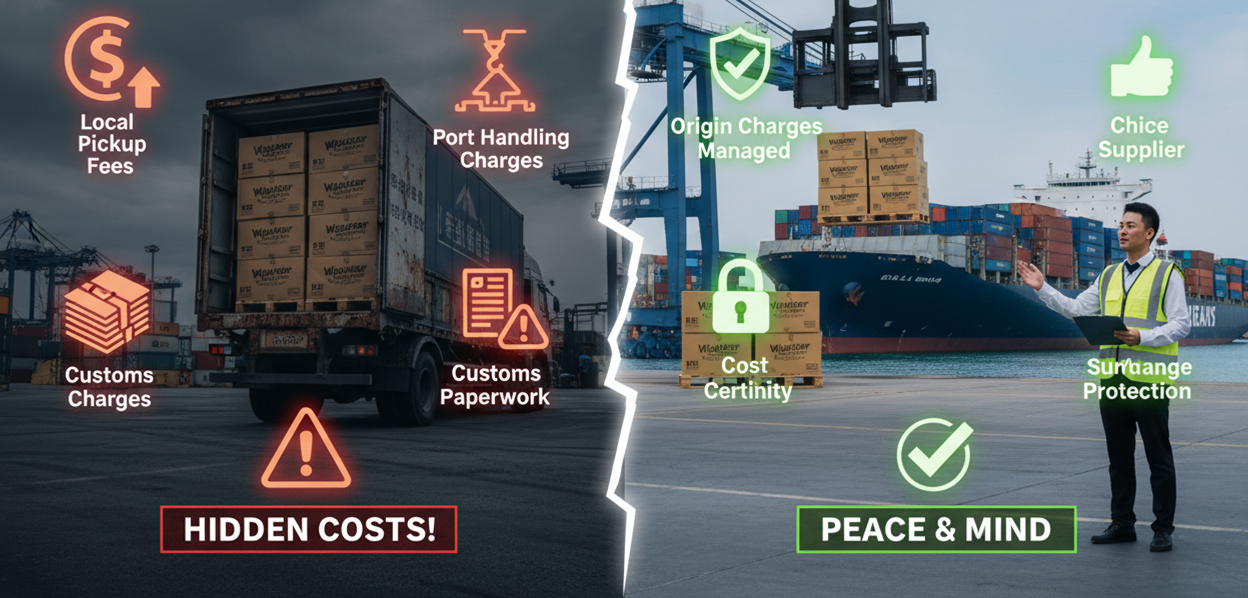
On paper, EXW unit quotes always appear cheaper than FOB quotes because they exclude local logistics inside China. However, EXW introduces several hidden costs that the buyer must pay separately, including origin trucking fees, export declaration charges, port handling, and warehousing fees. FOB quotes bundle these origin costs into the product price. For small to mid-sized importers, FOB often provides a simpler cost structure by eliminating unexpected local origin fees charged by freight forwarders.
Risk and Responsibility Division: Handling Transit Damage and Customs
Risk management differs significantly between these two terms. If goods are damaged during inland transit from a factory in Zhejiang to the port of Shanghai, the buyer absorbs the loss under EXW, whereas the factory remains liable under FOB. Furthermore, export customs clearance in China involves legal compliance. Under EXW, buyers must ensure their freight forwarder handles export filing properly. Under FOB, the Chinese factory uses its own export license to clear customs, reducing regulatory friction for complex outdoor items like electronic camping lanterns or specialized composite gear.
Logistics Control: Who Manages the Supply Chain Pace?
Logistics control is a primary deciding factor when choosing between EXW and FOB:
EXW gives the buyer total control over the entire transport chain from the factory floor. This requires a highly capable freight forwarder with active operations inside China.
FOB delegates Chinese origin logistics to the factory, allowing the buyer to focus purely on international ocean freight and destination clearance.
Selecting the right term depends on your internal supply chain capacity and whether you have reliable local logistics partners in China.
Practical Insights for Chinese Outdoor Gear Industrial Hubs
China’s outdoor equipment industry is concentrated in key manufacturing regions: Ningbo and Yongkang in Zhejiang for hardware and camp furniture, Weifang in Shandong for tents, and Guangdong for outdoor electronics.
Established outdoor brands often prefer FOB because factories in these hubs have streamlined, high-volume container shipping workflows.
Startup brands or buyers taking small sample runs across multiple factories may choose EXW to consolidate cargo into a single shipment at a centralized warehouse.
Real-World Cost Analysis: Tents and Camping Furniture Case Study
Consider an order of 1,000 camping tents shipped in a container. On an EXW basis, the factory price per unit might be lower, but the buyer must arrange separate local pickup, origin port handling, and customs documentation. If the buyer’s freight forwarder charges high local origin fees, the final landed cost per tent can end up higher than an FOB quote. Under FOB, origin charges are fixed and managed by the supplier, protecting the buyer from unexpected origin surcharges.
Decision Guide: Should You Choose FOB or EXW?
✅Choose EXW if you are consolidating Less than Container Load (LCL) shipments from multiple Chinese factories into one warehouse, or if you have an established freight forwarder offering competitive local inland rates inside China.
✅Choose FOB if you are shipping Full Container Loads (FCL), want a predictable origin cost, prefer to let the factory handle Chinese customs clearance, or want a simpler, hassle-free sourcing experience.
Many buyers also use a hybrid approach—starting with EXW for sample runs and switching to FOB for mass production.
Conclusion: Streamlining Your Outdoor Gear Supply Chain
Selecting between FOB and EXW is not just about comparing base prices; it is about managing risk, logistics control, and total landed costs. Understanding how origin charges, customs processing, and transit risks affect your bottom line allows you to build a reliable supply chain for your outdoor brand. Clear communication with your Chinese suppliers regarding trade terms ensures smooth production cycles and timely ocean delivery.
Frequently Asked Questions (FAQ)
Q1: Is EXW or FOB cheaper when sourcing outdoor gear from China?
While EXW offers a lower unit quote on the invoice, it excludes Chinese inland freight, export customs, and port charges. Once these additional costs are factored in, FOB and EXW often yield similar total landed costs. The overall value depends on your freight forwarder's local handling rates inside China.
Q2: Does the buyer handle Chinese export customs clearance under EXW?
Yes. Under EXW, the buyer is responsible for export customs clearance in China. In practice, buyers typically hire a Chinese freight forwarder or customs broker to process export documentation on their behalf.
Q3: How do specialized items like camping stoves or battery packs impact the choice between FOB and EXW?
Items containing lithium batteries, gas canisters, or liquid fuel require specific export declarations and safety documentation in China. Choosing FOB allows the local manufacturer, who understands domestic regulation requirements for specialized goods, to manage the export filing directly.
Q4: What is the risk of unexpected local charges under EXW?
Under EXW, designated freight forwarders may bill buyers for local origin surcharges, documentation fees, and warehouse handling fees that were not included in the initial shipping quote. Working with transparent logistics partners or choosing FOB helps prevent unexpected origin expenses.
Q5: Can I switch trade terms from EXW to FOB after receiving a quote?
Yes. You can request both EXW and FOB pricing from your Chinese supplier during the negotiation stage. Comparing both quotes alongside your freight forwarder’s origin shipping rates will help you determine the most cost-effective option before finalizing the purchase order.


 en
en ja
ja ko
ko zh
zh es
es ru
ru fr
fr ar
ar pt
pt tr
tr nl
nl it
it de
de

 RELATED MAGAZINE








 Leave a Message