Why CE and LFGB Certifications Are Essential for Entering the European Market
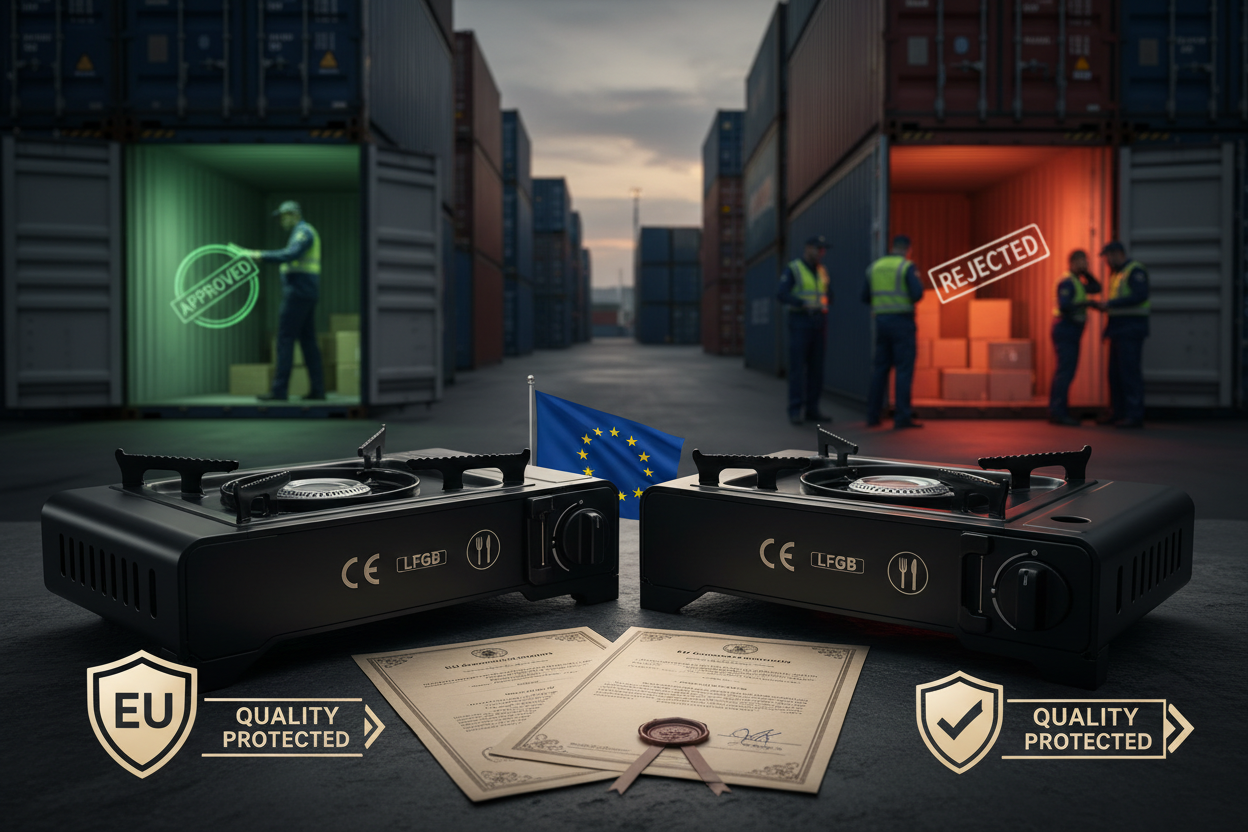
The European Union maintains some of the most rigorous consumer health and safety standards in the world. For outdoor cooking equipment, such as camping stoves, portable gas burners, and charcoal grills, compliance is mandatory. Non-compliant imports face severe risks, including customs confiscation, destruction of goods at destination ports, heavy administrative fines, and complete sales bans across EU member states. For importers, brands, and distributors, achieving proper certification is not merely a legal requirement—it serves as a foundational quality barrier that protects brand reputation, builds consumer trust, and ensures seamless customs clearance. Obtaining both CE marking and LFGB certification creates a complete compliance shield for your supply chain.
Understanding CE Certification: Mandatory Safety Access for the EU
The CE mark (Conformité Européenne) indicates that a product meets fundamental European safety, health, and environmental protection requirements. It serves as a passport allowing products to circulate freely within the European Economic Area (EEA).
Gas Appliances Regulation (GAR) 2016/426: Applies to appliances burning gaseous fuels. It mandates rigorous testing for gas tightness, flame failure protection, complete combustion, and explosion prevention.
Machinery Directive (MD) and Electromagnetic Compatibility (EMC): Apply to outdoor cooking devices containing moving mechanical parts, electric ignition systems, or integrated ventilation fans.
Products must undergo thorough technical evaluation before bearing the official CE logo.
Understanding LFGB Certification: Strict Safety for Food Contact Materials
While CE certification addresses structural and operational safety, LFGB (LMBG) focuses on chemical safety for materials coming into direct contact with food. Based on German food and feed law (§ 30 & 31) and overarching EU Regulation (EC) No 1935/2004, LFGB is recognized as one of Europe’s most stringent Food Contact Material (FCM) standards.
Scope of Testing: Cooking grates, grill plates, inner liners, and handles exposed to heat and food must undergo testing.
Chemical Migration Limits: Tests evaluate heavy metal leaching (such as lead, cadmium, nickel, and chromium), hazardous organic chemical residues, and heat resistance under high cooking temperatures.
Passing LFGB testing ensures that cookware components will not transfer toxic substances or alter the taste and odor of food.
Certification Variations Across Product Categories
Regulatory requirements vary depending on the stove or grill’s fuel source and mechanical design:
Portable Gas Stoves (Butane/Propane): Subject to the Gas Appliances Regulation (GAR). Tests focus on valve pressure, structural stability, gas leak prevention, carbon monoxide emissions, and heat dissipation.
Charcoal and Wood-Burning Grills: Typically exempt from GAR or electrical safety directives, but must comply with the General Product Safety Regulation (GPSR) for structural stability alongside mandatory LFGB testing for grates and fireboxes.
Electric Grills and Multifunctional Cooking Units: Require CE compliance under the Low Voltage Directive (LVD 2014/35/EU) and EMC Directive (2014/30/EU) in addition to FCM chemical safety tests.
The Complete CE and LFGB Testing and Certification Workflow
Navigating the certification process requires a structured approach to technical documentation and laboratory testing:
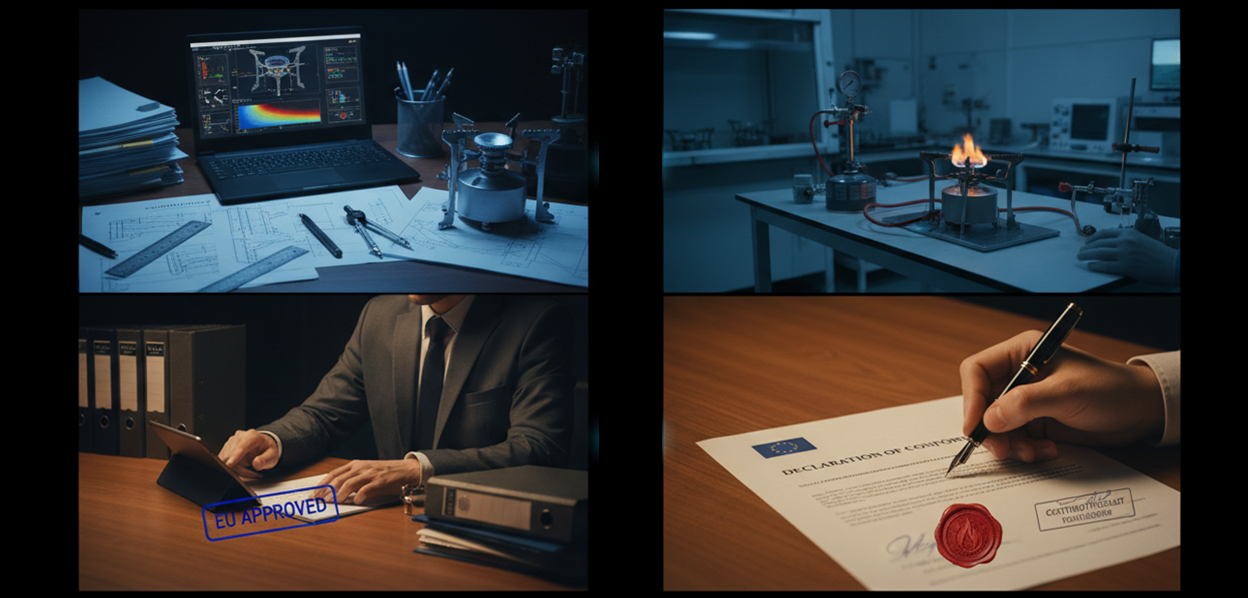
Technical Documentation Assembly: Compiling technical files, gas circuit schematics, bill of materials (BOM), exploded view diagrams, and user instruction manuals in European destination languages.
Laboratory Testing: Sending production-grade samples to accredited laboratories for pressure testing, flame stability checks, thermal endurance runs, and chemical migration analysis.
Notified Body Audits (for CE GAR): Engaging a recognized EU Notified Body to review technical files and issue Type Examination Certificates.
Declaration of Conformity (DoC): The importer or authorized manufacturer issues and signs an official EU DoC confirming full regulatory compliance.
Factory Audits and Ongoing Compliance Management
Certification is an ongoing process rather than a one-time event. Under CE GAR regulations, ongoing quality surveillance—such as Module C2 (Random Check) or Module D (Production Quality Assurance)—is required to maintain certificate validity.
Production Line Inspection: Manufacturers must implement In-Process Quality Control (IPQC) and Outgoing Quality Control (OQC) to ensure mass-produced units match the exact specifications of tested samples.
Material Alteration Protocols: Any change in raw material suppliers, metal alloys, non-stick coatings, or internal valve components requires a formal technical re-evaluation and potential certificate updates.
How to Identify and Verify Authentic CE and LFGB Documentation
Fake or misleading compliance documents present significant legal risks for importers. Common industry traps include fraudulent certificates issued by non-accredited entities or "Certificates of Conformity" that lack valid test reports.
Verifying CE Notified Bodies: Cross-check the four-digit Notified Body identification number listed on CE certificates against the official European NANDO (New Approach Notified and Designated Organisations) database.
Authenticating LFGB Reports: Verify test reports directly with accredited third-party testing institutions (such as SGS, TÜV Rheinland, Intertek, or Bureau Veritas) using report numbers and digital QR codes.
8. Legal Responsibilities of Importers: The EU Authorized Representative
Under European market surveillance regulations, non-EU manufacturers cannot place products directly on the market without a designated economic operator within the European Union.
EU Authorized Representative (EC REP): An entity based within the EU that retains technical files, acts as the primary contact point for market surveillance authorities, and assumes legal accountability for compliance.
Traceability and Labeling: Importer and EU Rep details, CE markings, batch/serial numbers, and safety warnings must be permanently printed on product rating plates, packaging, and user manuals.
Partnering with experienced manufacturers simplifies the compliance journey and lowers regulatory risks:
Evaluating Factory Infrastructure: Ensure the factory maintains specialized testing equipment, including automated air-leak detectors, gas flow meters, and spectral analyzers for raw material inspection.
Verification of Existing Certificates: Request current CE GAR and LFGB test reports from the factory and confirm whether the scope covers your specific product dimensions and modifications.
Contractual Risk Management: Require suppliers to sign a formal Letter of Conformity and non-infringement agreement, establishing clear accountability for manufacturing defects or compliance failures.
Conclusion: Building a Compliant and Resilient EU Supply Chain
Sourcing stoves and grills for the European market requires integrating regulatory compliance into your procurement process from the start. Obtaining valid CE and LFGB certifications ensures operational safety, protects food contact health, and facilitates smooth customs clearance across all EU member states. By partnering with qualified manufacturers, verifying certification documentation, and fulfilling EU Representative requirements, your brand can build a secure, scalable, and profitable supply chain. Contact our team today to request certified product catalogs or consult with our regulatory specialists.
Frequently Asked Questions (FAQ)
Q1: Can CE certification and LFGB certification replace one another?
No. CE certification focuses on physical, structural, gas, and electrical safety (preventing explosions, leaks, fires, and shock hazards). LFGB certification evaluates the chemical safety of components that come into contact with food (ensuring no toxic heavy metals or chemical residues leach into food). Stoves and grills imported into the EU typically require both certifications.
Q2: Do charcoal grills without electrical or gas components require CE certification?
Pure charcoal grills without electrical blowers or gas burners generally do not require CE marking under the Gas Appliances Regulation or Low Voltage Directive. However, they must comply with the EU General Product Safety Regulation (GPSR) for structural integrity, and all cooking grates must hold valid LFGB or EU 1935/2004 food contact certification.
Q3: How long does the CE and LFGB certification process take, and what are the costs?
Testing and certification generally take between 4 to 8 weeks, depending on product complexity and lab capacity. Costs vary based on product specifications. Gas appliances incur higher CE costs due to mandatory EU Notified Body involvement, while LFGB costs depend on the number and composition of food-contact materials tested.
Q4: Can an importer clear EU customs using a supplier's existing CE certificate issued under a different brand name?
No. Customs and market surveillance authorities require that the brand name, model numbers, and product details on the Declaration of Conformity (DoC) and shipping documents match the actual importer or brand selling the goods. Utilizing another brand's certificate can result in customs detentions or intellectual property disputes.
Q5: Is LFGB certification recognized in EU countries outside of Germany?
Yes. While LFGB is a German national standard, its testing requirements meet and exceed the general requirements set by EU Regulation (EC) No 1935/2004. Products that pass LFGB testing are accepted across all EU member states and represent a recognized benchmark for food contact safety.


 en
en ja
ja ko
ko zh
zh es
es ru
ru fr
fr ar
ar pt
pt tr
tr nl
nl it
it de
de


 RELATED MAGAZINE







 Leave a Message