The outdoor recreation industry is experiencing unprecedented growth, with camping grills becoming an essential centerpiece for outdoor lifestyle enthusiasts. As global market demand expands, brand competition intensifies. For outdoor gear brands, B2B buyers, and product managers, maintaining strict Quality Control (QC) throughout manufacturing is the single most important factor in protecting brand reputation, reducing Return Merchandise Authorization (RMA) rates, and ensuring end-user safety.
Implementing a comprehensive, end-to-end QC program guarantees that every unit shipped from the factory meets international safety standards and consumer expectations. Here is a detailed guide to mastering quality control in wholesale camping grill production.

Introduction: The Critical Role of Quality Control in Wholesale Camping Grill Manufacturing
Wholesale manufacturing involves high-volume production runs where a minor flaw in design or assembly can quickly propagate into thousands of defective units. Camping grills operate under harsh outdoor conditions, dealing with extreme heat, direct open flames, and unpredictable weather.
Inadequate quality control leads to product returns, negative customer reviews, structural failures, or severe safety hazards like gas leaks and fires. A structured QC strategy shields your brand from liability, controls warranty replacement costs, and fosters long-term customer loyalty in a competitive market.
Establishing Raw Material Standards and Incoming Quality Control (IQC)
Quality begins long before assembly. Incoming Quality Control (IQC) verifies that raw materials and outsourced components conform to agreed technical specifications before reaching the factory floor.
Material Composition Testing: Verify alloy grades for stainless steel (e.g., 304 vs. 430), cold-rolled steel, cast iron, and high-temperature coatings using X-ray Fluorescence (XRF) analyzers.
Gauge Thickness Tolerances: Measure sheet metal thickness rigorously to prevent factories from using thinner gauge metals, which compromises structural integrity and increases thermal warping.
Component Inspections: Conduct random batch testing on critical accessories, including cooking grates, gas control valves, regulator hoses, igniters, and assembly hardware.
Precision Manufacturing: Quality Checks During Sheet Metal Stamping and Cutting
The fabrication phase transforms raw metal sheets into structural grill components. Precision checks during cutting and stamping ensure effortless final assembly and user safety.
Dimensional Tolerance Control: Monitor laser-cutting and CNC stamping machines to maintain strict dimensional accuracy across panels, legs, and draft vents.
Deburring and Edge Finishing: Inspect cut edges for sharp burrs. Metal edges must be smoothed, deburred, or hemmed to prevent end-users from sustaining injuries during setup or cleaning.
Bending and Joint Alignment: Verify bending angles on press brakes to guarantee tight seams and smooth folding mechanisms.
Structural Integrity and Welding Process Inspection
Strong joints and welds prevent structural collapses when the grill is loaded with cookware, charcoal, or heavy meats.
Weld Joint Evaluation: Inspect spot welds, TIG/MIG welds, and automated robotic welds for uniformity, penetration depth, and mechanical strength.
Defect Prevention: Reject components exhibiting false welding, burn-through holes, missing weld spots, or excessive slag buildup.
Static Load Testing: Apply weight stress tests to folding leg mechanisms and grate supports to ensure they exceed rated load capacities without wobbling or collapsing.
Surface Coating, Heat Resistance, and Corrosion Protection QC
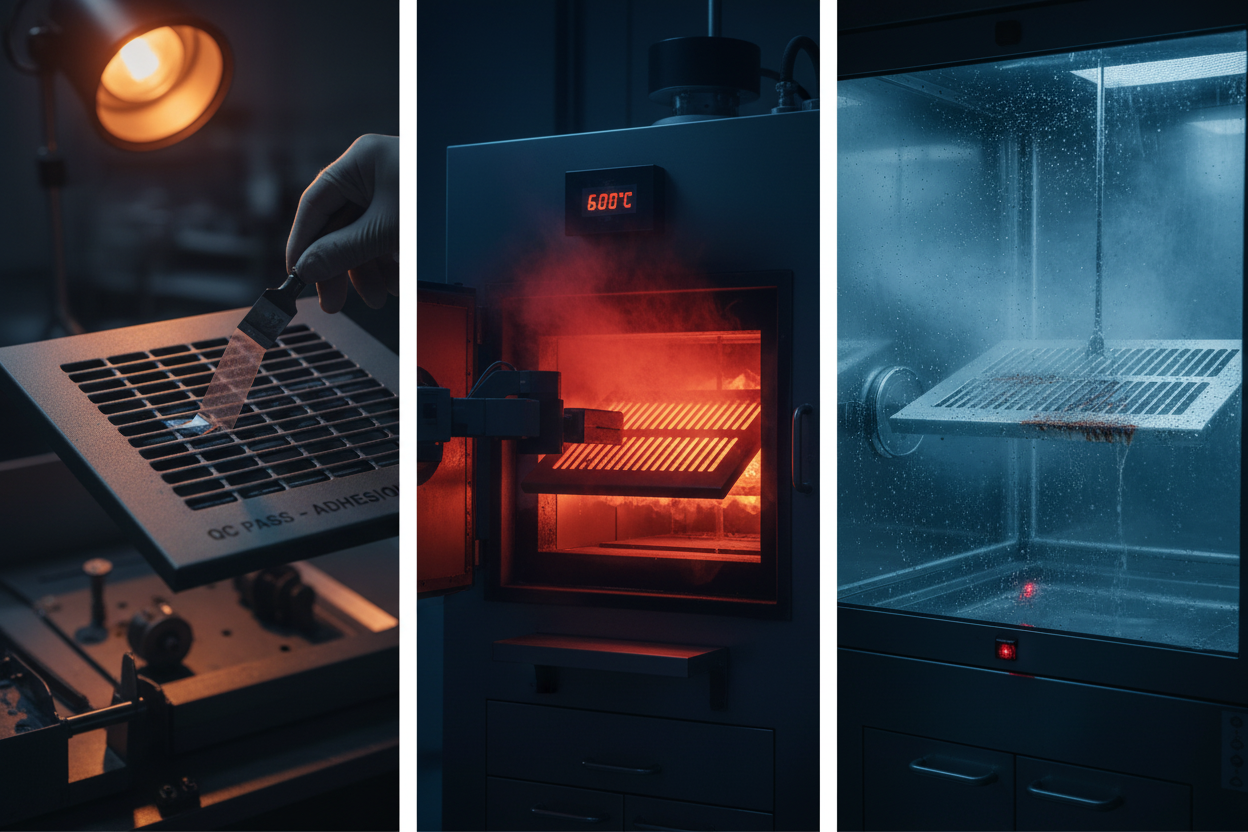
Outdoor grills require specialized surface treatments to withstand high temperatures and damp environmental conditions.
Coating Adhesion Testing: Perform cross-hatch tape tests on high-temperature powder coatings and heat-resistant paints to verify surface adhesion.
Thermal Endurance Testing: Expose coated panels to temperatures between 300°C and 600°C to verify that paint will not bubble, flake, or emit toxic chemical fumes during operation.
Salt Spray Resistance: Conduct Neutral Salt Spray (NSS) chamber testing to evaluate long-term rust and corrosion resistance under humid outdoor conditions.
Assembly Line Quality Control (IPQC) and Functional Testing
In-Process Quality Control (IPQC) monitors the assembly line in real time to catch operator errors and mechanical misalignments immediately.
Tool-Free Assembly Checks: Randomly select units off the line to ensure folding mechanisms, latches, and detachable legs operate smoothly without requiring specialized tools.
Component Completeness: Audit packed hardware kits to ensure no screws, washers, handles, or wind deflectors are omitted.
Four-Point Flatness Check: Place fully assembled grills on a calibrated flat surface to verify all contact points rest firmly without shaking or rocking.
Safety Compliance and High-Temperature Fire Testing
Operational testing under real-world fire conditions confirms that grills function safely and efficiently before mass packaging.
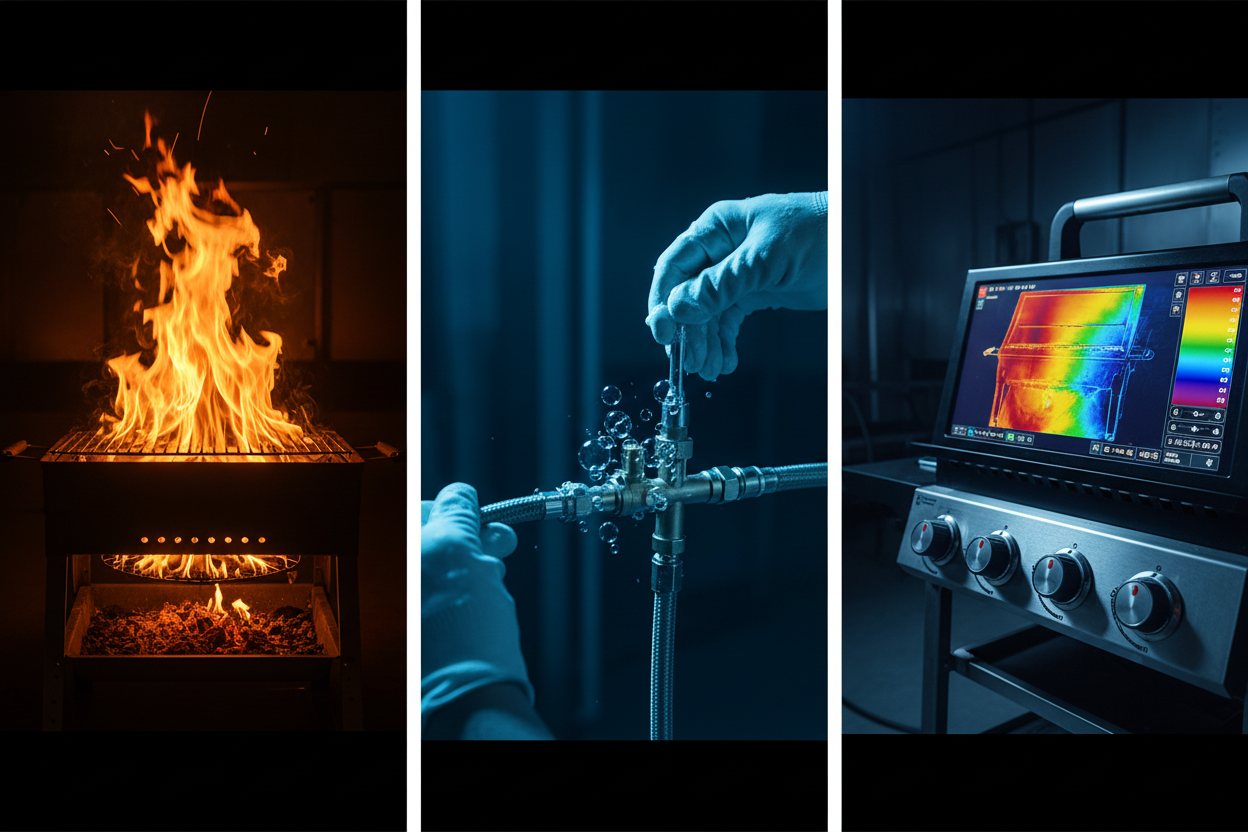
Charcoal Grill Burn Tests: Conduct sample charcoal burn tests to verify airflow ventilation, heat distribution, ash pan containment, and metal warping resistance.
Gas Leakage and Valve Testing: Perform 100% pressurized gas leak tests (bubble or electronic sniffer tests) on gas models, alongside piezoelectric ignition success rate testing.
Heat Insulation Verification: Measure surface temperatures on handles, knobs, and carrying grips to confirm thermal insulation protects users from burns.
Packaging Quality Control and Transit Stress Testing
Even a perfectly manufactured product is useless if it arrives damaged due to poor packaging. Packaging QC guarantees safe transit through global supply chains.
Box Drop Testing: Execute ISTA 1A or 2A drop tests on master cartons and individual retail boxes to simulate rough handling during ocean and last-mile shipping.
Internal Cushioning Audit: Ensure expanded polyethylene (EPE) foam, bubble wraps, and protective films are positioned correctly to prevent metal-on-metal scratching.
Labeling Accuracy: Verify shipping marks, barcodes, moisture-proof warnings, country-of-origin tags, and instruction manual inserts.
Final Random Inspection (FRI) and Outgoing Quality Control (OQC)
Before goods leave the factory, Outgoing Quality Control (OQC) conducts a comprehensive Final Random Inspection (FRI) on finished production lots.
AQL Sampling Standards: Apply international ISO 2859-1 (ANSI/ASQ Z1.4) sampling tables to determine inspection sample sizes based on total batch volume.
Defect Classification: Categorize findings into Critical Defects (zero tolerance for gas leaks, sharp edges), Major Defects (functional failures, severe wobbling), and Minor Defects (cosmetic scratches, minor packaging scuffs).
Third-Party Audits: Engage accredited third-party inspection agencies (such as SGS, BV, or Intertek) to generate impartial pre-shipment inspection reports.
Building Long-Term Supplier Relationships for Continuous Quality Improvement
Mastering quality control is an ongoing process built on collaboration between brand owners and OEM manufacturing partners.
CAPA Execution: Implement structured Corrective and Preventive Action (CAPA) protocols whenever defects are identified, requiring factory management to address root causes.
Regular Factory Audits: Conduct periodic factory audits to review equipment calibration schedules, worker training programs, and raw material storage hygiene.
Co-Engineering for Efficiency: Work closely with engineering teams to refine grill designs, improving structural strength while simplifying manufacturing complexity.
Frequently Asked Questions (FAQ)
What AQL standard should be used for wholesale camping grills?
Wholesale camping grill orders generally follow the ANSI/ASQ Z1.4 (ISO 2859-1) standard. Recommended Acceptable Quality Limits are: Critical Defect: 0 (zero tolerance for safety issues like gas leaks or sharp edges), Major Defect: 2.5 (functional or structural issues), and Minor Defect: 4.0 (minor cosmetic blemishes or packaging imperfections).
How do you test the coating durability on a barbecue grill?
Coating durability is evaluated using three primary tests: 1. Cross-Hatch Adhesion Test to verify paint bonding strength; 2. High-Temperature Bake Testing, raising temperatures to 400°C–600°C for 2 hours to check for peeling or bubbling; and 3. Neutral Salt Spray (NSS) Chamber Testing to measure rust resistance over extended hours of moisture exposure.
What are the most common defects in wholesale camping grills?
The most frequent manufacturing defects include sharp burrs along sheet metal cut edges, thermal panel warping during extended high-heat use, weak spot welds on folding legs, powder coating flaking off near heat zones, and missing assembly screws or accessories in retail boxes.
Should gas camping grills and charcoal camping grills follow the same QC checklist?
While basic physical structure, packaging, and coating checks are identical, their operational testing differs. Gas grills require 100% gas leak testing, valve pressure checks, and ignition testing. Charcoal grills focus primarily on ventilation draft efficiency, ash catch pan fitment, and thermal deformation resistance during live wood or charcoal burns.


 en
en ja
ja ko
ko zh
zh es
es ru
ru fr
fr ar
ar pt
pt tr
tr nl
nl it
it de
de

 RELATED MAGAZINE







 Leave a Message